As the world embraces an ever-increasing number of mobile devices, the demand for innovative mobile applications surges. In the USA, where smartphone users are projected to reach 311.53 million by 2025, the mobile app development market is booming. This article explores the top 20 mobile application development companies in the USA, shedding light on their services, client reviews, and key focus areas. Discover the best iOS and Android app developers that can turn your ideas into reality.
Here's what you'll learn:
- Top companies: Explore detailed profiles of 20 leading app development firms. Discover their services, hourly rates, team sizes, and expertise areas.
- Key factors to consider: Before you make a decision, learn the crucial factors to evaluate, including company size, client testimonials, hourly rates, and development focus.
- Finding your perfect partner: Gain essential tips to help you select the ideal app development company for your specific needs and budget.
Whether you're a seasoned entrepreneur or just starting out, this comprehensive guide will empower you to choose the best mobile app development partner for your success.



- Mobile App Development in the USA: Market Outlook
- 20 Best App Development Companies in the USA
- ChopDawg.com
- TekRevol
- Tapptitude
- Blue Label Labs
- Zco
- hedgehog lab
- Sidebench
- STRV
- Designli
- Groovy Web LLP
- Fueled
- Confianz Global, Inc
- CitrusBits
- Dogtown Media
- Dedicated Developers
- Technology Rivers
- Red Foundry
- Sunflower Lab
- Impekable
- Eight Bit Studios
- Consider Inoxoft Your Trusted Partner
- Final Thoughts
Last year, the number of mobile devices used worldwide was about 15 billion. But, this number is expected to grow and reach 18.22 billion by 2025.
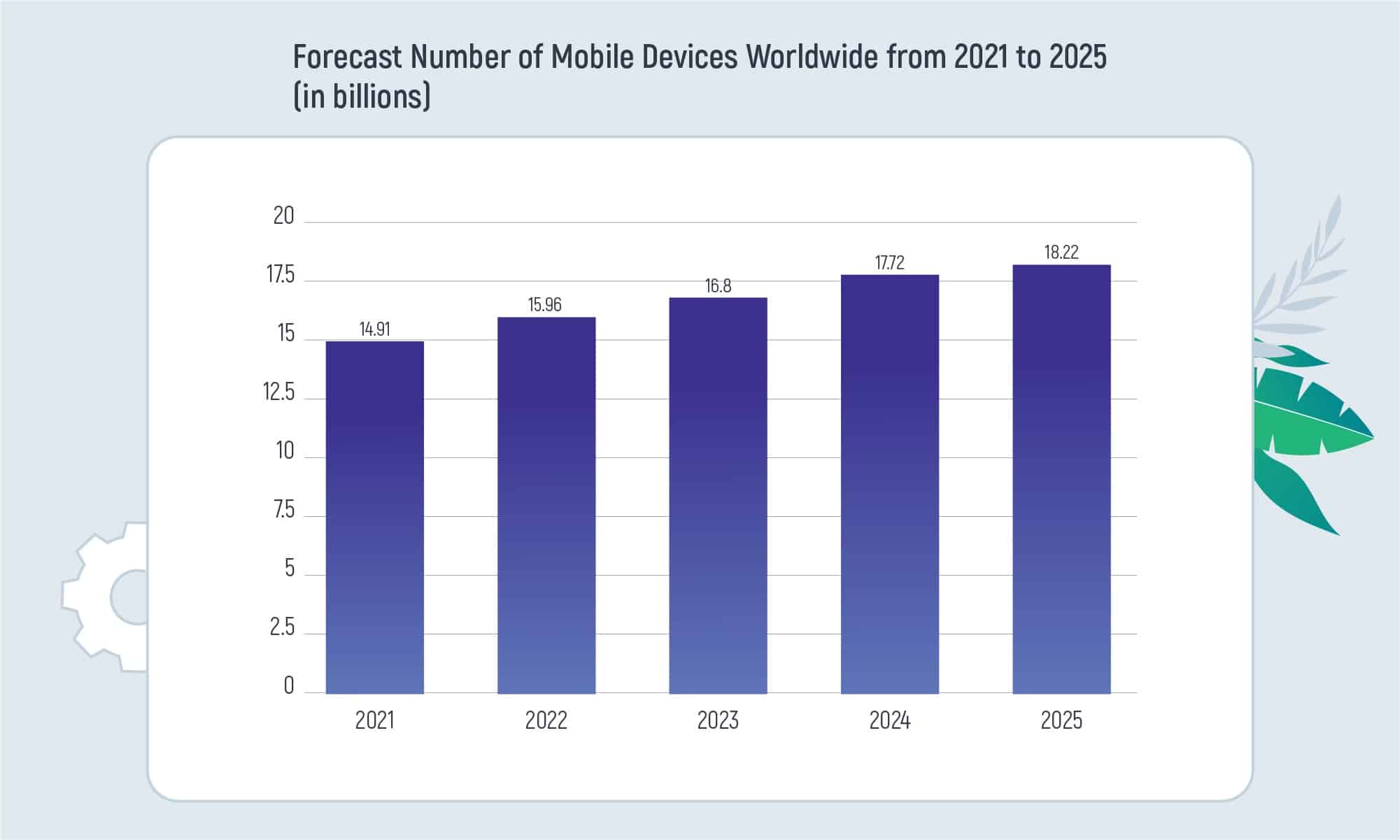
The situation in countries is fueled by the introduction of 5G and 6G internet connections. And, by the opportunities, one hand-size mobile device can give to its user. It’s convenient to use, text, phone, and video phone people, study, pass important procedures, make doctor appointments, check your bank account balance or check your home safety cameras, and, even work. Anything is possible. That’s why people are eager to have a mobile phone at their service. The more people adore phones, the more mobile app technologies companies produce. And it happens to be a great business in the digital world.
In the U.S. alone, the number of smartphone users was 298 million in 2021. And it is expected to reach 311.53 million by 2025.
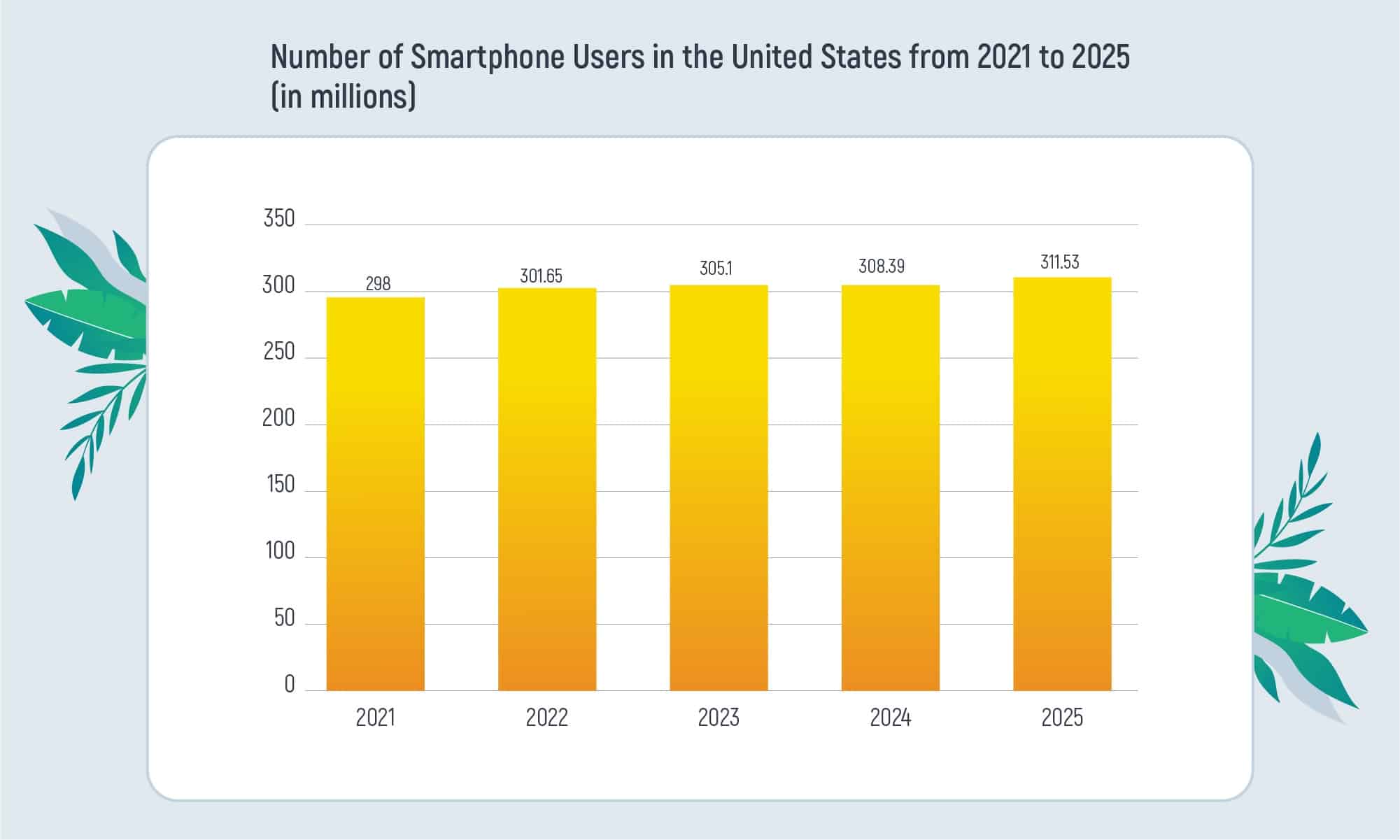
So, the United States is a great place to produce mobile technology. And a lot of companies do their best to deliver the most innovative market solutions. Based on this information, can you tell what are the best app development companies in the USA? Or, maybe, where to find the top app developers in the US? If you’re eager to know, stay with us and read further!
Mobile App Development in the USA: Market Outlook
Industry ARC says that the mobile application development market is going to reach $20.7 billion by 2025 in the USA. Here, the CAGR will be 21.7%, which is quite a lot. With everything roaming around mobile applications, organizations in America and all around the world are adopting mobile platforms in their day-to-day processes.
Mobile apps enhance business activities, make them faster and of better quality, provide better management, tracking, automate manual work, customize and personalize workers’ daily routines. The main states of mobile software development are San Francisco, Los Angeles, Boston, New York, and Chicago. According to Google Trends, the most searched companies with mobile app development in the USA were in Kansas, Georgia, New York, Virginia, and Oregon.
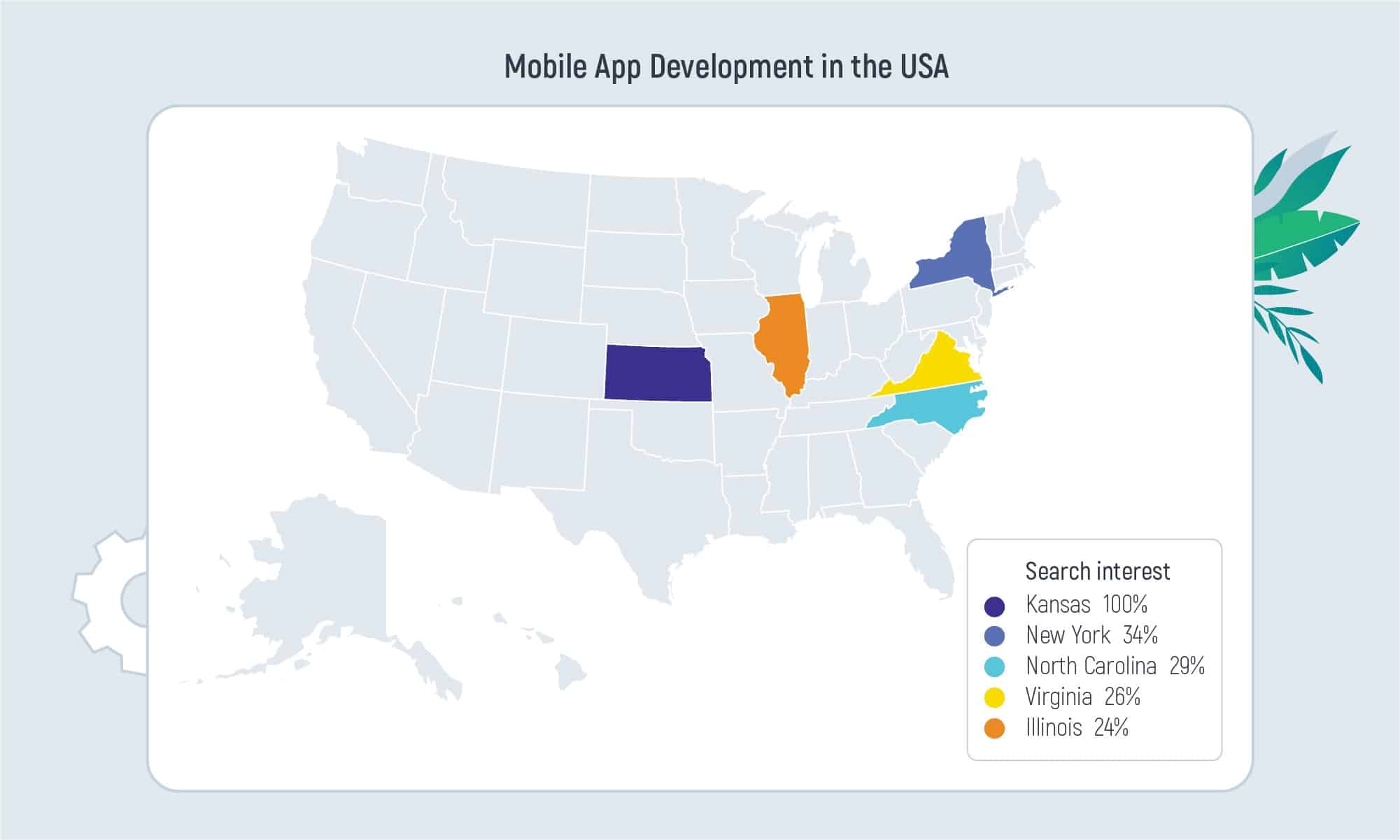
So, let’s explore the top app development companies in the USA and find out which mobile app development companies in the USA provide the best services. The list of the companies is chosen based on Clutch and GoodFirms reviews.
20 Best App Development Companies in the USA
How can anyone search for top mobile app development firms in the USA? Searching for the best mobile app developers in the USA is not easy, for there are 50 states and each of them provides excellent mobile app development services in the USA.
To make this process a bit easier, let’s explore a list of 20 mobile application development companies that you might want to work with. Or hire app developers. All of these companies provide 50+% of mobile development services.
ChopDawg.com
It is a company located in Philadelphia, PA founded in 2009. It includes up to 50 employees that have launched more than 350 innovative apps. ChopDawg’s hourly rate varies from $100 to $149. Besides mobile app development, the company’s main focus is on
- cross-platform apps for iOS, Android, and web
- technologies that emerge (mixed reality, IoT, voice recognition, wearables, AI)
- product Strategy, and Prototyping
- UI/UX design
- app branding
- sites built with WP
- mobile backend development
- integration of app analytics
- quality assurance services
The company has 4.9 stars and 60 reviews from its clients. The key clients are Mister Softee, LA Gear, Choice Home Warranty, Petland, University Of Washington, Barkly Pets, Hilton, Six Flags Great Adventure, Wawa, Siemens, Toiyabe Indian Health Project, PetKey, Mari Fitness, Flynn O’Hara, Innovative Vending Solutions, Rhodes 101 Convenience Stores, Buddy Project, DemCon, Cuzzo Trivia, and Steps Insitu.
TekRevol
The company is located in Houston, TX, and was founded in 2014. It was launched as a Silicon Valley startup. Nowadays, TekRevol includes up to 250 employees. The company’s single developer makes $25 – $49 per hour. Besides mobile app development the company delivers
- AR/VR technologies
- AI services
- blockchain
- web development
- consulting and SI
- ERP consulting and SI
The company also has 4.9 stars, but the number of reviews is smaller – it’s 51. The key clients of TekRevol are The University of Toronto, Waste Connections, Oz Leasing, Beach Bandits, The Star, and Little Star Pizza, The Mobius Risk Group, The Arrow Recovery Group, and UCSF – University of California SF.
Tapptitude
Tapptitude is located in New York, NY. It was founded in 2017 and has grown up to 250 developers. The company’s development hourly rate is $50 – $99 an hour. Besides mobile apps, the company also offers
- product strategy and definition
- UX/UI design
- mobile and web development
- backend engineering
- AI, machine learning, and data science
- quality assurance services
- product launch, and product growth
The company achieved 4.9 stars among its competitors and currently has 47 reviews. Its key clients are Tenor, Glorify, Wellory, Ontapp, OxWash, Speaken, Olly, Shebah, SAP, Turk Telekom, ETH Zurich, Discogs, Imobiliare, Telenav, and Honda.
Blue Label Labs
The company is also located in New York, NY. But, it was founded in 2009. Now they have about 250 employees. The company’s mobile development expert takes $100 – $149 per hour. The main focus of Blue Label Labs falls on
- mobile app development
- UI/UX design
- web development
Despite having 44 reviews, the company has 4.8 stars among its peers. Blue Label Labs is proud to have worked with the following key clients: Bloomberg News, Microsoft, Google/Alphabet, Fender, PayPal, United Nations, iHeart Media, Major League Baseball Player’s Association, El Dorado Airport, Hello Sitter, Magic Money, Muncheez, and HowUdish.
Zco
Zco is located in Nashua, NH. It was founded as far as 1989. Now, the company includes up to 1000 employees. Their hourly rate is pretty humble despite the agency’s size. It’s $25 – $49 an hour. The main focus of Zco is on
- mobile apps and games
- enterprise platforms
- web-apps
- custom integration of hardware
- Big Data
- VR/AR
- UI/UX design
- 3D animation
The company receives 4.7 stars for its efforts. And, there are 47 reviews. Key clients that are pleased with Zco services are Golflogix, Volkswagen, Microsoft, Harvard University, Eversource, Dartmouth University, BBC America, Keystone Automotive, Samsung, APR Energy, Massachusetts, Management Sciences for Health, APR Energy, The Morning Star Company, Utz Quality Foods, and American Hotel and Lodging.
hedgehog lab
From Boston, MA, the hedgehog lab was founded in 2007. Almost 250 employees work at the company now at the hourly rate of $100 – $149 per hour. Besides mobile development hedgehog lab is interested in
- web development
- UI/UX design
It receives 4.7 stars and 44 reviews on Clutch. The company’s big clients are Deliveroo, Standard Life Aberdeen, LaserShip, Leisure Pass Group, E.ON Energy, AkzoNobel, Santander, Deliciously Ella, CMC Markets, B&M Stores, Kodak Alaris, and Royal Pharmaceutical Society.
Sidebench
Located in Santa Monica, CA, Sidebench was founded in 2012. It has 250 employees on board and the pricing of $150 – $199 for one hour. The main focus of the company covers
- mobile app development
- custom software development
- UI/UX design
Sidebench receives 4.9 stars and has 38 reviews. Among their customers, you can see Microsoft Corporation, Facebook, Instagram, Red Bull, Sony, NBCUniversal, Andreessen Horowitz, Accel, Lightspeed Ventures, Oakley, Pabst Blue Ribbon, Imagine Entertainment, Legendary, United Talent Agency, Pressed Juice, Children’s Hospital Los Angeles, UCSF Clinical Innovation, and American Heart Association.
STRV
STRV comes from Los Angeles, CA. It was founded in 2004 and grew to 250 staff members. The company’s rate is $100 – $149 an hour. Its main focus also covers
- product management
- AI, ML, data engineering
- UX/UI design
- mobile app development
- web development
- quality assurance
On Clutch, STRV has 4.8 stars as a service provider. And, 38 reviews. The company’s key clients are Microsoft, The Athletic, ClassDojo, Hallmark, Barry’s, MedMen, Opkix, LegalZoom, Eaze, Songclip, Lufthansa, Boosted, and AiFi.
Designli
The top mobile app development company in the USA is from Greenville, SC. It was founded in 2013. There are almost 50 employees, each with an hourly rate of $100 – $149. The main focus of Designli falls on
- mobile app development
- UI/UX design
- web development
- web design
The company receives 5 stars and has 33 reviews. Their best clients include ClubUp, LLC, Thingealogy, Arrow Food Couriers, and Arrow Food Couriers.
Groovy Web LLP
Another great mobile application development company in the USA is located in Katy, TX. Founded in 2015, the company continues to grow up to 250 employees. The hourly rate Groovy Web offers is less than $25. The main focus of the company is on
- mobile app development
- web development
- custom software development
Groovy Web has 5 stars and 33 reviews on Clutch. Their top world clients are MyCribBooking Malaysia, XtraRecharge India, BuyandSellOffers USA, Pipeline Management Australia, Maji Masseuse London, Vitim & Cyberfish AG Switzerland, BowlersMart USA, Jive Market, swiss skyways services ag, and Swiss Skyways Switzerland.

Fueled
Fueled, which is from NYC, NY, was founded in 2007. They have grown to 250 employees and take $150 – $199 per hour of their work. The main focus of the company is on
- mobile development
- UI/UX design
- blockchain
- web design and development
Fueled receives 4.8 stars and has 32 reviews. Their key clients include MGM Resorts International, 9Gag, Harvard, Rite Aid, Verizon, Crunchbase, Afterlight, QuizUp, Summit Series, Barneys, Happify, Sunnycomb, and Matador.
Confianz Global, Inc
Located in Charlotte, NC, Confianz Global was founded in 2008. Now there are up to 250 staff members. The company’s hourly rate is quite average – $25 – $49 per hour. Their main focus is only on
- mobile app development
Confianz Global has 4.8 stars and 30 reviews. Their key clients are AT&T, Short Run Pro, Killarney Metals, Computer Bracket Solutions, Federal Brace, Mednet, Gridizen LTD., Element Designs, Nascent Technologies, Grunt Style, Apptega, Stout Stuff, and Toledo Zoo.
CitrusBits
A company from Los Angeles, CA. it was founded in 2005. There are only 50 employees. The price for their services is $100 – $149 an hour. The main Focus of CitrusBits is on
- mobile app development
- AR/VR development
The company receives 5 stars on Clutch and has 29 reviews. The big-name clients of CitrusBits are Burger King, Quiksilver, J&J, DuPont, National Geographic, Harman Kardon, Symantec, Sotheby’s, FullyRaw. And, startups: FullyRaw, IrisVision, and The Winning Seat.
Dogtown Media
Los Angeles, CA is one of the cities with the best software developers. Dogtown Media is the best app development company in the USA. It was founded in 2011. It counts 50 people on board and requires a $100 – $149 hourly payment. The main focus of the company is on
- mobile app development
- AI
- IoT
- wearable app development
The company has 4.9 stars and 29 reviews. Its core clients include Google, Lexus, United Nations, CitiBank, Red Bull, YouTube, Minneapolis Heart Institute, University of California San Diego, Card.com, Macy’s, Sharp Medical Center, Oxford Immunotec, University of Oklahoma, and Fayr.
Dedicated Developers
Dedicated Developers is from Alpharetta, GA. It was founded in 2007. There are 50 company employees now. The hourly rate is quite high for such a small company – $50 – $99 per hour. The main focus of the company falls on
- mobile app development
- web development
The company has 5 stars among its competitors and 29 reviews. Big-name clients that are core for the company are Corning Gorilla Glass, Kripalu, Walmart, Get Momentum, Growth Oracle, Get Altitude, MOBE, WIRED, Condenast, University of Massachusetts Amherst, ONTRAPORT, In Touch EMR, Spotify, and Gym Source.
Technology Rivers
The company is located in Reston, VA. It was founded in 2007. Now it includes 50 employees. They ask for $50 – $99 an hour. Its main focus is on Healthcare/HIPAA and on
- mobile app development
- custom software development
- web development
There are 4.9 stars rate of the company and 29 reviews. Key clients of Technology Rivers are Johns Hopkins Hospital, Phone2Action, K2M (now part of Stryker), eMocha Health, Felt App (Handwritten Greeting Cards), Ripcord.io, Qlarant, FirstMate Services, BOSSS, JPAR, Thanks.io, Sickweather, Eddy (eddynow.com), MARI, ISO New England, and League Apps.
Red Foundry
The company comes from Chicago, IL. It was founded in 2009. Now there are 50 employees and they are rated for $150 – $199 per hour. The main focus of the company is on
- mobile app development
- application management and support
- UX/UI Design
- web development
Red foundry has 4.9 stars and 28 reviews. The clients of Red Foundry are Cooper’s Hawk, Traveling Vineyard, Fortis Global, RacketStats, WhatIfWe World, Vacation by Rail, Clark Brands, Galaxy Digital, Gearflow, Random House, Reader’s Digest, BuyFluidly, Central Insurance, Utrip, Fodor’s Travel Guides, Pearl Jam, Kodak, Panasonic, Wine Enthusiast, Systagenix, StoryTime, Internet Brands, Purohit Navigation, KTVA Alaska, and Fautus.
Sunflower Lab
Located in Yonkers, NY, Sunflower Lab was founded in 2010. The company has up to 250 employees. The hourly rate of the best mobile app development company in the USA is $50 – $99 / hr. The main focus of the company covers:
- mobile app development
- custom software development
Sunflower lab receives 4.7 stars and has 28 reviews. Its core clients include AM best, Nationwide Insurance, Brivity, Vishay, and Accurate NeuroMonitoring.
Impekable
Impekable is located in San Jose, CA, and was founded in 2012. Now, there are up to 50 staff members and their average hourly rate is $150 – $199. The main focus on the company lies on
- mobile app development
- UI/UX design
- web development
There are 4.8 stars given to Impekable and 28 reviews. Their key clients are Google, Nike, Adobe, Twilio, Netgear, Accenture, Panasonic, Pentair, and Central.
Eight Bit Studios
The company was founded in 2009 in Chicago, IL. It has grown up to 50 employees and quite a high rate – $150 – $199 / hr. The main focus of the company is on
- UX/UI design
- mobile app development
- web development
This app development agency in the USA has 4.9 stars and 28 reviews. Their big clients include Echo Global Logistics, UL, New Balance, Trident, Hasbro, GrowIt, and LyteShot.
Consider Inoxoft Your Trusted Partner
Inoxoft is an international mobile development services company with a lot of professional experience. We have more than 7 years of delivering custom solutions for the mobile OS such as custom android app development. Clients all around the world turn to our company and hire mobile app developers to meet various business needs and requirements.
We also focus on providing software development for the USA. That’s why our certified developers know how to structure our work, how to communicate the right way with business owners, how to get the most essential details, and build consistent mobile applications for your business. For instance, see our sports tracking app solution.
With us you will obtain:
- solutions according to your requirements
- attention to detail and your personal vision
- met deadlines as discussed in the contract
- the most talented development team
- the most effective and fast technologies
- a comprehensive consultation/demo
- a Discovery Phase service
Find out how much does it cost to hire an app developer for your project!
Choose us to become your trusted partner. Receive the best experts in mobile development for years ahead.
Final Thoughts
Overall, the mobile app development landscape in the USA is dynamic and thriving, driven by technological advancements, entrepreneurial spirit, and a commitment to delivering innovative solutions that enhance user experiences and drive business growth.
Insights:
- Rising Demand for Mobile Devices: The surge in mobile device usage globally, projected to reach 18.22 billion by 2025, is fueled by advancements like 5G and 6G connectivity. This highlights a growing dependency on smartphones for various tasks beyond communication, such as banking, healthcare, and work-related activities.
- Thriving Mobile App Development Industry: The robust growth in mobile device usage has created a lucrative market for mobile app development. With the industry poised to reach $20.7 billion by 2025 in the USA alone, companies are capitalizing on the demand for innovative solutions to enhance business operations and customer experiences.
- Key Hubs for Mobile Software Development: Cities like San Francisco, Los Angeles, Boston, New York, and Chicago serve as epicenters for mobile software development in the USA. These regions attract top talent and foster a conducive environment for innovation and collaboration, driving the growth of the industry.
- Diverse Range of Services Offered: Mobile app development companies offer a comprehensive suite of services, including product strategy, UI/UX design, backend development, and integration of emerging technologies like AI, AR/VR, and IoT. This diversity enables businesses to tailor solutions to their specific needs and stay ahead of the competition.
- Top App Development Companies: Several companies stand out for their exceptional services and client satisfaction. Examples include ChopDawg.com, TekRevol, Tapptitude, Blue Label Labs, and Zco, among others. These firms have a track record of delivering high-quality mobile solutions across various industries, earning them praise from clients and recognition in the industry.
- Geographical Distribution of Leading Companies: While major cities like New York and Los Angeles host prominent app development firms, other states like Texas and Massachusetts also boast reputable companies. This dispersion indicates the widespread availability of talent and expertise in the USA’s mobile development landscape.
- Clientele and Partnerships: App development companies collaborate with diverse clients, ranging from startups to multinational corporations. Clients include renowned brands like Google, Microsoft, Nike, and Verizon, reflecting the industry’s ability to cater to varying business scales and requirements.
- Emphasis on Quality and Innovation: The consistently high ratings and reviews of top app development companies underscore their commitment to quality, innovation, and client satisfaction. These firms prioritize delivering cutting-edge solutions that meet client objectives and exceed industry standards.
- Affordable Options for Mobile Development: Despite the prevalence of high-profile firms, there are also options available for businesses with budget constraints. Companies like Groovy Web LLP and Dedicated Developers offer cost-effective solutions without compromising quality, making mobile development accessible to a wider range of clients.
If you happen to search for a mobile app development company in the USA, you may find a vast pool of options. But, to choose the best iOS/Android app development company in the USA, it is vital to conduct some research. First of all, the company has to be highly rated on Clutch or GoodFirms – trustworthy sources about providers of mobile application development in the USA. Then, it is best to acknowledge the size of the company and its main focus. Third, it would be great to know who their previous clients were and if there were any big-name ones.
Last, but not least, explore the company’s hourly rates and customer feedback. As these might show you what kind of developers they are. Also, consider having a call with your future service provider, which might be the most decisive factor. Good luck in your search!


Frequently Asked Questions
How to find the best mobile app development company in the USA?
The choice has to be based on some defining factors such as company name, rating, reviews, focus, pricing, key clients. Consider every option that suits your values, project technology, timeframes, and budget.
What are the best states/cities with app developers in the USA?
According to one source these are - San Francisco, Los Angeles, Boston, New York, and Chicago. And, according to the other - Kansas, Georgia, New York, Virginia, and Oregon.
What is the future of mobile app development companies in the USA?
The companies located in America are to grow further and innovate. The mobile application development market is going to reach $20.7 billion by 2025. And, this means, people are fond of mobile apps, businesses strive to automate processes with the help of mobile apps, so developers have a lot of work to do. The market is to expand and even outreach predictions.