













A resident reports a broken appliance through the portal, emails a photo the next morning, and calls the office when there is no update. If those interactions remain separate, answering each one faster does little to solve the underlying service problem.
The need for dependable follow-through is visible in Buildium’s 2026 Renters’ Report. In its survey of 1,500 US renters, 24% identified maintenance as the most stressful part of the resident experience, while 84% expected a response from their property manager within 24 hours. These findings describe service expectations, rather than the effectiveness of a particular AI product.
AI resident support automation can help collect complete requests, retrieve approved information, send accurate updates, and route work to the right person. To be useful, the software needs to connect the resident’s conversation with the systems and teams responsible for the outcome.
This guide compares eight software development companies with relevant capabilities in residential property software, conversational AI, workflow automation, and enterprise integration. It explains which experience is directly relevant and where buyers should request further evidence before commissioning a custom solution.








Key Takeaways
- Resident support covers the period after move-in, including service requests, maintenance updates, account questions, community information, and ongoing communication.
- Evaluate the complete service workflow. An instant acknowledgment is different from a correctly recorded request and a completed next step.
- Ask providers to demonstrate residential property processes and AI behavior separately. General chatbot experience does not establish expertise in both.
- Compare a configured product, a custom extension, and a tailored application before choosing a full build.
- PMS access, identity verification, property-specific information, and human escalation should be defined before rollout.
- Assess cost per completed workflow alongside resident feedback, repeat contacts, record accuracy, and staff correction effort.
How to Evaluate Resident Support Automation Development Companies
Check Whether the Experience Matches Existing Residents
A leasing chatbot and a resident-support assistant serve different users. Leasing work usually concerns prospects, availability, and tours. Resident support involves an existing relationship with a property, unit, lease, and service history.
Ask the provider to demonstrate a resident checking an open work order, correcting a request, asking about an amenity reservation, and requesting a person. Inspect the records and staff tasks created by those interactions.
Evaluate the Workflow Behind the Assistant
The system should have a defined route from message to action. Identify where the resident record lives, which tool holds the work order, who owns the next step, and which source provides the latest status.
Ask how the provider will handle duplicate requests, unavailable integrations, reassigned staff, and residents contacting the team through several channels. Those situations are central to service delivery rather than optional enhancements.
Test Property Context and Information Access
A portfolio may contain buildings with different amenity rules, maintenance arrangements, service hours, and escalation contacts. The assistant must use the right information for the right property.
Have vendors demonstrate how the software identifies the resident and unit, restricts account-specific information, and handles unclear or conflicting records. A correct answer for one community can be wrong for another.
Review Escalation and Staff Controls
Define which requests can be handled automatically and which need a person. Include urgent maintenance concerns, disputes, sensitive account questions, and any resident explicitly asking for human support.
Staff should be able to take ownership, pause automated responses, correct a record, and inspect what happened. Test whether the assistant continues messaging after a human has taken over.
Assess Maintenance After Launch
Property information, team responsibilities, and software interfaces change. Ask who updates knowledge, tests revised workflows, monitors integrations, and responds to incidents.
Confirm repository access, ownership of custom components, third-party licensing, and transition arrangements. The implementation should have an operating plan as well as a development plan.
Software Development Companies to Shortlist
Company data was checked on October 29, 2026. Team sizes and hourly rates below are Clutch listing bands, rather than audited headcounts or binding quotes. Review totals may change.
The companies offer different combinations of property software and AI engineering. Inclusion does not mean each has a published deployment of the exact resident-support system you need. The “Best for” descriptions are editorial fit assessments, and the numbering is for navigation rather than an audited ranking.
Inoxoft publishes this article and is included in the shortlist. Providers may use international delivery teams. Confirm engineering locations and support coverage directly if those are procurement requirements.
1. Inoxoft
- Founded: 2014
- Team Size: 50–249
- Clutch: 5.0 / 5, 74 reviews
- Hourly Rate: $25–$49/hr
Best for: residential operators and PropTech teams that need a custom resident-service application or an automation workflow connected to existing software.
Inoxoft’s real estate software services cover resident-facing applications, property management, communication, and operational workflows. Its conversational AI services add custom assistants, business-system integration, and human handoffs.
A relevant project might connect request intake with property and unit identification, work-order records, staff assignments, and resident updates. The scope can also include the operational interface staff need to supervise the service.
Inoxoft’s published resident-services platform provides evidence of residential workflow engineering. That case should be distinguished from a production AI support deployment. Ask for a demonstration of the proposed automation using your request types, integration requirements, and escalation procedures, with acceptance criteria for both resident interactions and staff outcomes.
2. HatchWorks AI
- Founded: 2016
- Team Size: 250–999
- Clutch: 4.9 / 5, 29 reviews
- Hourly Rate: $50–$99/hr
Best for: operators evaluating resident-facing AI assistance alongside maintenance coordination and integration with existing property systems.
HatchWorks AI’s real estate software offering explicitly describes resident and tenant support through chat and voice, work-order routing, call summaries, and ticket updates. It also lists property knowledge search and connections with PMS, CRM, and work-order tools.
This makes it directly relevant to a shortlist focused on resident-service workflows rather than prospect qualification alone. The proposed assistant could be one component of a wider operational application.
Ask what is included in the first implementation and which capabilities require customization. Evaluate how status changes reach residents, what happens when a record is unavailable, and how the system stops or resumes automation when staff take ownership. Request project evidence supporting the particular integrations proposed.
3. Ascendix Technologies
- Founded: 1996
- Team Size: 50–249
- Clutch: 4.9 / 5, 16 reviews
- Hourly Rate: $50–$99/hr
Best for: property businesses needing custom resident portals and operational integrations, with AI added to a defined workflow.
Ascendix’s property management software development services cover property applications, resident portals, resident databases, document access, and related community-management functions. The same offering includes AI consulting, integration, and development.
Consider Ascendix when the underlying resident-service environment needs work before conversational automation can be useful. A portal, reliable records, and clear workflow ownership may be as important as the AI interface.
Ask the team to show residential support examples, rather than assuming commercial brokerage CRM experience covers the same needs. Define the role of AI in request intake, information retrieval, or communication, and separate it from conventional workflow functionality. Confirm the proposed application’s dependencies and ongoing maintenance responsibilities.
4. Fingent
- Founded: 2003
- Team Size: 250–999
- Clutch: 4.9 / 5, 66 reviews
- Hourly Rate: $25–$49/hr
Best for: residential organizations connecting property operations with conversational support and business-system integrations.
Fingent’s PropTech services include property management, tenant engagement, leasing, and maintenance-related software. Its conversational AI offering describes assistants connected to enterprise information, customer-service systems, and human support.
The combination is relevant when an answer depends on information spread across a portal, a maintenance tool, and another business application. It can also support staff assistance before introducing broader resident-facing automation.
Ask for a demonstration using a resident’s existing request history and property-specific policies. Confirm how the system identifies the user, avoids disclosing another resident’s information, and reports a failed update. Published capabilities should be validated through the workflow and platforms your team actually uses.
5. Itransition
- Founded: 1998
- Team Size: 1,000–9,999
- Clutch: 4.9 / 5, 42 reviews
- Hourly Rate: $25–$49/hr
Best for: larger organizations modernizing resident portals, case management, and property-system connections within an established application environment.
Itransition’s real estate software services include residential property management, tenant requests, document storage, and property portals. Its real estate CRM offering describes customer-service cases, routing, self-service portals with AI assistants, status monitoring, and field-service scheduling.
Consider Itransition when resident support is part of a wider modernization initiative involving several systems and internal teams.
Ask which platform configuration, custom engineering, and AI components the proposal includes. For an existing application, request a staged rollout plan that preserves current support channels. A useful demonstration should show a request moving between systems and a staff member resolving an exception, rather than only a chatbot answering a question.
6. Chetu
- Founded: 2000
- Team Size: 1,000–9,999
- Clutch: 4.3 / 5, 82 reviews
- Hourly Rate: Undisclosed
Best for: operators needing custom property-software integration and support automation across an existing technology stack.
Chetu’s real estate software services cover property applications and integrations. Its custom chatbot development services include conversational interfaces, business-process automation, messaging channels, and ongoing support.
These capabilities are relevant where resident communication must connect to operational software, rather than run as an isolated assistant. The exact residential workflow still needs validation.
Ask the proposed team to demonstrate request creation, status retrieval, and handoff on your systems. Review recent client feedback as part of due diligence and agree clear milestones for integration behavior and usability. Since its hourly rate is undisclosed, request a scoped quote with separate recurring costs and support responsibilities.
7. Velvetech
- Founded: 2004
- Team Size: 250–999
- Clutch: 5.0 / 5, 22 reviews
- Hourly Rate: $50–$99/hr
Best for: property organizations improving service operations through custom integrations, staff assistance, and resident-facing AI functionality.
Velvetech’s real estate software offering includes property systems, customer relationships, and software integration. Its generative AI services describe employee assistants, customer assistants, task automation, custom applications, and maintenance.
Consider Velvetech when the project needs to improve both what residents experience and the tools staff use behind the scenes. A staff copilot and a resident-facing assistant can share selected information while retaining different permissions.
Ask which functions are demonstrated in comparable projects and which would be new development. Review how the solution connects a conversation with a work item, records exceptions, and gives staff a way to correct generated summaries or proposed actions.
8. ScienceSoft
- Founded: 1989
- Team Size: 250–999
- Clutch: 4.8 / 5, 46 reviews
- Hourly Rate: $50–$99/hr
Best for: organizations prioritizing controlled AI actions, enterprise integration, and operational oversight in a custom support workflow.
ScienceSoft’s AI agent development services cover enterprise data access, workflow execution, authorized integrations, human approvals, testing, and monitoring. Its chatbot services describe conversational assistants, business-system connections, and handovers.
This is relevant capability for a resident-support application that needs to retrieve information and create or update records. The published services establish broader AI engineering experience, rather than proving a specific residential resident-support deployment.
Ask for a property-specific demonstration and evidence for the proposed integrations. Test limited permissions, missing resident information, and a failed action. Confirm who investigates incidents and who approves changes to the assistant’s operating boundaries.
How to Choose the Right Resident Support Automation Partner
Begin With a Service Problem You Can Measure
Choose a first workflow based on actual resident contacts. Repeated maintenance status questions, incomplete requests, or difficulty finding community information can each justify a different implementation.
Document the current process and baseline. Measure repeat contacts, time spent collecting missing details, reassigned requests, and staff effort required to find the latest status.
Agree what an improvement means before development. A quick acknowledgment should not count as resolution if a staff member still needs to reconstruct the request.
Compare Configuration, Extension, and Custom Development
A ready-made resident-support product may already provide the required channels and integrations. A custom extension may address a specific gap without replacing it.
A tailored application is worth evaluating when the operator needs distinctive portfolio rules, an unusual integration, or a staff and resident experience unavailable through configuration.
Ask finalists to explain the alternatives. The decision should include implementation cost, recurring fees, ownership of custom components, data export, and the resources needed to operate the service.
Use a Shared Set of Resident Scenarios
Give each finalist the same tasks and inspect the resulting records. Include a new request, an update to an existing request, a corrected unit number, a message with an attachment, and a request to speak to a person.
Test a resident moving between channels. The system should not lose the issue history or create a second job simply because the latest message arrives by email instead of the portal.
Include unavailable integrations and outdated source content. Ask the team to show how staff discover and correct those problems.
Verify the Operating Cost and Ownership
Separate engineering from model usage, hosting, messaging, storage, integrations, and support. Estimate expected demand and a busier period using explicit assumptions.
Agree who owns property content, on-call contacts, knowledge updates, incident response, and workflow changes. Confirm what your team can administer without a development request.
The chosen partner should explain how the service will keep working when properties are added, staff change, or a third-party platform updates its interface.
How Inoxoft Can Help With AI Resident Support Automation
Inoxoft can help residential operators define and build a connected support workflow around their existing systems or a new resident-service application.
An initial implementation might collect a resident’s request, identify the property and unit, retrieve an existing work order, and prepare the next step. Where authorized integrations are available, the software can create or update a record, notify the responsible team, and send a confirmation based on the actual result.
The staff interface matters as much as the resident interface. Operators need visibility into unresolved requests, failed integrations, handoffs, and generated content requiring review. A useful scope includes these supervision tools rather than leaving them for a later phase.
Case Study: Digital Resident Services for a US Amenity Management Business
Inoxoft’s digital resident-services platform case describes a US amenity and lifestyle management company replacing fragmented coordination with a connected platform.
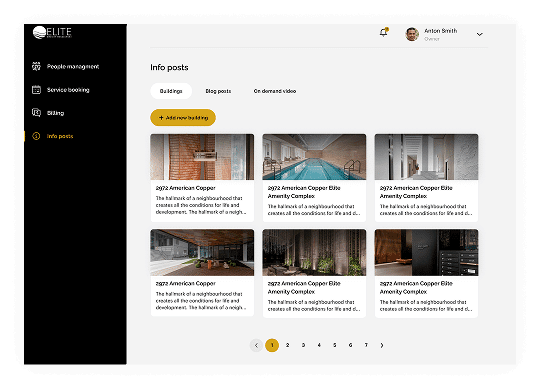
The delivered software combined a resident mobile application with a staff web platform. It supported amenity bookings, service requests, reservation management, payments, notifications, and operations across multiple residential communities.
For resident-support automation, the relevant evidence is the underlying service workflow: giving residents a way to submit requests and staff a way to manage the work. An AI assistant needs dependable records and processes of this kind.
The case demonstrates residential software engineering. It does not establish that the delivered platform included an autonomous resident AI assistant.
Case Study: Integrations for a Customer-Service Knowledge Platform
In a separate knowledge-management platform engagement, Inoxoft provided frontend, backend, and integration support for a product serving customer-service teams.
The client described a platform intended to help teams handle call volume and reduce escalations. The engagement involved extending functionality into other platforms and supporting the product’s development capacity.
This is adjacent evidence for the information and integration layer around support operations. It complements the resident-platform case without implying that the two engagements formed one residential AI deployment.
A next step for a prospective buyer is a scoped demonstration of the specific resident workflow, with agreed inputs, integrations, escalation behavior, and acceptance criteria.
Select the Delivery Model Around the Initiative
For a new application with validated direction, Inoxoft’s Product Development services can structure an agreed first production release. Define resident journeys, staff workflows, essential integrations, and acceptance criteria before broadening the scope.
For an existing or actively developed application, an AI Pod within a dedicated development team can work in the client’s repository and release process. The client’s Product Owner sets priorities and accepts work, while the pod handles technical execution and delivery.
For a contained integration or product core, the One Man Army model provides a senior AI-assisted engineer. A larger resident-support implementation may need additional specialists and a broader team, depending on integrations, evaluation, and ongoing operation.
Frequently Asked Questions
What is AI resident support automation?
It is the use of AI and connected software to handle defined resident-service tasks. Examples include gathering request details, finding approved property information, retrieving a ticket’s status, preparing updates, and routing issues to staff. The implementation should define what remains under human control.
How does resident support differ from leasing automation?
Leasing automation primarily serves prospective residents through inquiries, qualification, and tour scheduling. Resident support serves people already living at a property. It needs existing account context, service history, property policies, and connections to operational teams.
Which tasks should be automated first?
Start with a frequent, bounded problem supported by usable information and a clear next step. Request intake, status retrieval, and community-information questions are possible candidates. Use your contact data and staff feedback to choose the first scope.
Can the system manage maintenance requests?
It can be designed to collect details, find an existing request, and submit or update a work order through an authorized integration. Test required fields, property matching, duplicates, and failures. A successful conversation should produce a usable record for the team.
Can it send residents updates automatically?
Yes, when the relevant status information is available and the workflow authorizes the communication. Messages should reflect actual system events rather than assumptions. Define when updates are sent, when they are paused, and how staff override them.
Can an assistant answer lease or account questions?
Potentially, if the resident is appropriately identified and the required information is accessible. Define the permitted questions and the route for disputes or ambiguous terms. The system should not invent an explanation when the source information does not resolve the issue.
How should urgent issues be handled?
Use a procedure approved by the operator, including escalation contacts, fallback steps, and a clear human route. Test realistic examples and unavailable staff. The system should record the outcome and avoid claiming a person has been reached when the escalation failed.
Can residents still speak to a person?
They should have an explicit way to do so. Define the experience during and outside staffed hours. Test whether a human takeover pauses automated replies and whether the staff member receives the information already collected.
Can one assistant serve several residential properties?
It can, if property identification, information separation, and permissions are designed for that scope. Test similar community names and different policies. Adding properties should include a defined process for approving information and validating routing.
Can it work across portals, email, SMS, and voice?
That depends on the selected channels, services, and integrations. Establish how conversations are linked to the same resident and request. Evaluate continuity and duplicate prevention rather than assuming multiple channels automatically provide a unified experience.
What resident data should the application access?
Limit access to information required for the agreed task. Define roles, permitted actions, retention, and access to transcripts or logs. Test residents with shared contact details, changed tenancies, and restricted accounts before exposing sensitive information.
Do we need custom development or a ready-made product?
Compare available products with your essential workflows and integrations. Configuration may be sufficient; a custom extension may solve a specific gap. A full build needs a clear justification and an owner for ongoing maintenance.
How much does implementation cost?
Cost depends on workflow complexity, channels, integration access, information quality, evaluation, and support. Ask for a scoped engineering estimate and a separate recurring-cost model. Directory rates alone cannot establish the full budget.
How long does implementation take?
The schedule depends on the first release and its prerequisites, including system access, property content, escalation decisions, and testing availability. Separate early validation from production rollout and agree acceptance milestones for each phase.
How should we measure whether it works?
Track completed workflows, record accuracy, repeat contacts, unresolved issues, handoff success, staff correction effort, and resident feedback. Compare those measures with the baseline. A higher automated-response rate is not sufficient if residents still need to chase the same request.


