














Real estate software can support very different businesses. A property manager may need a resident portal connected to maintenance and accounting systems. A brokerage may need listing search and lead management. A PropTech founder may be building a SaaS product for several property operators.
Each of these needs different workflows, integrations, and delivery arrangements. So start by naming the application you need and what you want the development company to own.
The list focuses on companies that build or extend software for clients. If an existing property management product can do the job through configuration or integration, look at that option before you commission a custom application.








- Key Takeaways
- What Real Estate Software Development Companies Build
- 20 Real Estate Software Development Companies to Consider
- How to Compare the Best Real Estate Software Development Companies
- Evaluating Real Estate SaaS Software Development Companies
- Where AI Can Support Real Estate Applications
- A Real Estate Development Example From Inoxoft
- How Inoxoft Supports Real Estate Product Development
- Final Thoughts
Key Takeaways
- Compare real estate software development companies against the workflows, users, integrations, and operating requirements of your project.
- Property management systems, listing platforms, resident applications, and commercial real estate tools require different expertise.
- A published client project tells you more about relevant experience than a general industry service page.
- Real estate SaaS products need account structures, tenant isolation, subscriptions, onboarding, and repeatable configuration across customers.
- Confirm access to listing data and external systems before you rely on integrations in an estimate.
- Look at delivery responsibilities and total ownership cost as well as engineering rates.
- Choose a delivery model that fits a first release, ongoing product development, or a contained initiative.
What Real Estate Software Development Companies Build
Property Management Applications
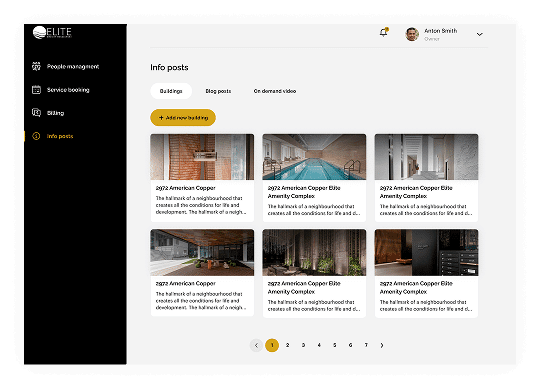
Property management software can connect properties, units, residents, leases, maintenance requests, payments, documents, and reporting.
The scope depends on the operator. A residential portfolio, a commercial building, a homeowners’ association, and a serviced accommodation business may all run things differently.
Our property management software development services cover applications built around those operational requirements.
Leasing and Brokerage Platforms
Leasing software can support enquiries, property viewings, application documents, follow-ups, and coordination between agents and applicants.
Brokerage platforms may also need CRM integration, listing distribution, agent permissions, and reporting.
Define the records each system owns and the events that move a prospect through the workflow.
Listing Portals and Marketplaces
Property search applications may include filters, maps, listing administration, saved searches, notifications, and contact or booking workflows.
External listing feeds add requirements around access, permitted use, refresh schedules, duplicate records, and unavailable data.
A marketplace connecting several parties also needs clear ownership of listings, enquiries, moderation, and transactions.
Resident and Building Services
Resident applications can support amenity bookings, service requests, visitor access, notifications, and communication with building teams.
These products often connect to systems that already manage residents, access permissions, payments, or work orders.
How the integration behaves counts as much as the interface. If a request shows as submitted, you should be able to trace it through the system that’s responsible for completing it.
Commercial Real Estate Tools
Commercial applications may support lease information, building operations, vendor coordination, document workflows, portfolio analysis, and reporting.
Discovery should pin down what information asset managers, property teams, finance staff, tenants, and external partners need.
Real Estate SaaS Products
A SaaS platform serves several customer organisations through a repeatable product.
On top of the core real estate workflow, it may need customer onboarding, account administration, subscription management, configurable permissions, and isolation between organisations.
Plan for those requirements in the architecture and testing from day one.
20 Real Estate Software Development Companies to Consider
1. Inoxoft
Inoxoft provides custom software engineering for real estate businesses and PropTech products. Its services cover application design, web and mobile development, integrations, quality assurance, cloud delivery, and AI functionality.
A published resident-services project describes a digital concierge platform for a US amenity and lifestyle management company, covering amenity bookings, payments, service requests, and operations across residential communities.
Its delivery models fit different product stages:
- Product development services for a validated product direction and an agreed first production release.
- A dedicated development team for defined initiatives within an existing or actively developed application.
- The One Man Army model for a contained scope that one senior engineer can build and test using AI-assisted workflows.
Consider for: Resident platforms, property operations software, integrations, and PropTech products requiring a defined delivery scope.
2. Fingent
Fingent publishes a property technology case study for Rentmoji, a platform for a US property management firm.
Fingent brought the whole property management lifecycle into one product suite built on Microsoft .NET, with Android and iOS apps for field-service work.
That’s a good place to start if you want to check its experience with operational workflows and connected apps. Fingent lists offices in New York, Melbourne, Sydney, Dubai, Kochi, and Bangalore.
Consider for: Property management platforms that need to coordinate office operations, field teams, and customer-facing services.
3. Iversoft
Iversoft documents a real estate project for Ashcroft Homes involving custom touchscreen kiosk software for its luxury sales centres.
Buyers can view, compare, and customise floor plans on touchscreens running on Mac minis. Iversoft also built the API integration and a custom CMS, plus a tablet version so staff can show options to international buyers who can’t visit.
The case covers property sales experiences, not a full property management system.
Consider for: Interactive property presentation, sales-centre applications, and customer-facing real estate interfaces.
4. Uruit, a Nortal Company
Uruit publishes work involving Building Engines, a commercial real estate platform that JLL acquired in 2021.
Building Engines serves more than 750 clients managing 25,000 buildings. Administrators, tenants, vendors, and other building staff each log in to get the data they need.
Uruit’s nearshore team in Colombia and Uruguay worked alongside the client’s in-house team in Boston, rebuilding legacy code and adding features such as maintenance and inspections.
Consider for: Commercial property applications and ongoing engineering for platforms serving building managers, tenants, and service providers.
5. Netguru
Netguru documents development work for Home Made, a London lettings agency focused on homes above £500,000.
A team of five built the lettings platform from scratch in 13 weeks, with a Node.js backend, a Salesforce-based CRM integration, and tools that pull in property data from different sources.
That helps if your software has to serve customers and internal teams at the same time, including workflows that don’t fit one standard process.
Consider for: Lettings platforms and PropTech applications requiring product design and engineering around specialised workflows.
6. Brainvire
Brainvire offers real estate software services covering property management, CRM, and related applications.
Its published property search and investment case describes a LAMP web application for a London real estate firm. It matches buyers with properties and the best available realtor, and lets the client control which realtors appear to which customers.
Brainvire is headquartered in Plano, Texas. Check which parts of that project look like the product you’re planning.
Consider for: Property search platforms, real estate CRM, and applications connecting customer enquiries with property or investment information.
7. Novateus
Novateus publishes a real estate application example involving Falaya, a platform connecting property buyers and sellers.
Its real estate offering also covers property management and customer-facing digital tools.
That transaction-focused example tells you more than its general industry capabilities.
Consider for: Property sales platforms and web or mobile products connecting buyers, sellers, and real estate service workflows.
8. TeaCode
TeaCode documents development work for Buzzin, a touchless visitor and access management product for buildings.
Buzzin runs on iOS, Android, and web, and TeaCode reports 232% growth in its mobile user accounts between 2021 and 2024. It’s a focused building-access product, so don’t treat it as proof of experience with every part of a property platform. TeaCode is based in Warsaw.
Consider for: Resident applications, visitor management, and products connecting mobile users with building access workflows.
9. Appinventiv
Appinventiv publishes a real estate development offering covering property search, rentals, brokerage workflows, tenant engagement, and investments.
Its listed integrations cover CRM, ERP, payment gateways, maps, document tools, and MLS or other property databases.
Its case studies include ILITY, a white-label SaaS platform for commercial property owners that reports a 40% rise in occupancy, and Slice, a fractional property ownership app for the UAE market.
Consider for: Mobile-led real estate products requiring several connected services and a supporting application backend.
10. TechAhead
TechAhead offers real estate application and software development.
It builds property listing, management, marketplace, and investment apps. Its real estate projects include Boxlty, a property discovery app with IoT-based identity verification and property access, and RentalHost, a property management platform for rental hosts.
TechAhead is headquartered in Agoura Hills, California. Clarify which parts of your project need custom development and which rely on existing systems.
Consider for: Property apps that combine mobile interfaces, property access or IoT features, and business-system integrations.
11. EB Pearls
EB Pearls publishes a dedicated PropTech offering.
The Sydney-based company names three PropTech projects: Coposit, a payment app for off-the-plan property purchases; Rello Pay, a payments and vendor finance platform; and MYBOS, a building management platform used across more than 3,000 buildings.
Check requirements and integrations against the market your product will run in. Payments work, for example, brings AML and KYC compliance with it.
Consider for: PropTech platforms connecting customer journeys with payments or building-management processes.
12. Plego Technologies
Plego publishes a case study for Skipify.ai, a real estate skip-tracing and lead-generation product for wholesalers, flippers, and other property professionals.
Plego, based in Chicago, built the web app, including property search by address, county, or zip code, CSV uploads and exports, and credit tracking. It’s a specialist data and prospecting tool, so judge it separately from leasing or property management requirements.
Consider for: Real estate data tools and lead-management applications where data sources, access, and permitted use can be clearly established.
13. Software Mind
Software Mind publishes nine real estate case studies.
Its case-study collection includes replacing VBA macros with a custom application, auditing a real estate system and its infrastructure, and integrating two property search and management platforms.
Those examples fit businesses that rely on systems that have become hard to maintain or extend.
Consider for: Real estate reporting, system assessment, modernisation, and continued engineering for existing applications.
14. Apptunix
Apptunix offers real estate software development across marketplaces, listing discovery, transaction platforms, and related applications.
It lists map-based search, saved searches with alerts, listing administration, and MLS, IDX, and RETS feed integrations. Named clients include Keller Williams and HouseSigma.
The company claims sub-100ms search across more than 10 million listings. Test claims like that against your own workloads.
Consider for: Property marketplaces and listing applications requiring search, administration, and integration with external property information.
15. Saritasa
Saritasa publishes real estate development services covering CRM, listing platforms with virtual tours, property management, and tenant and lease management.
Its projects include ZinCasa, an iBuyer real estate platform, and the OpenHouseDay web app. The company has offices in Irvine, California, and Tampa, Florida.
In a project discussion, find out who’d be on your team and which capabilities are backed by comparable completed work.
Consider for: Custom real estate applications combining property information, customer interaction, and internal workflows.
16. Chetu
Chetu offers real estate management and property management software development.
It lists multi-property interfaces, cloud architecture, task automation, and compliance modules for REO and foreclosed properties, with integrations including Rent Manager, Propertyware, Guesty, and ATTOM.
Chetu is headquartered in Sunrise, Florida. Its services fit applications that coordinate information and activity across several properties.
Consider for: Property operations platforms, multi-property administration, and custom workflow automation.
17. Matellio
Matellio publishes a real estate software offering covering listing applications, CRM, mobile products, and connected business functions.
Its wider services include custom software, integrations, cloud infrastructure, and modernisation.
For a real estate project, ask how they’d put those capabilities together around the first complete user workflow.
Consider for: Custom property applications and operational systems requiring application development and integration work.
18. MindInventory
MindInventory offers real estate software development covering CRM, property and tenant management, brokerage, portfolio management, HOA software, and MLS solutions.
Named real estate clients include The Baya Company, a developer, and Snug, an Australian PropTech business.
Ask for project evidence with similar users, data sources, and operating requirements before you choose a delivery setup.
Consider for: Custom real estate management applications where the provider can demonstrate relevant implementation experience.
19. Intuz
Intuz offers custom real estate software development alongside web, mobile, cloud, IoT, and AI engineering.
Its real estate page covers CRM, HOA and property management, MLS software, and IDX and RETS integrations, plus AR/VR features with IoT.
Projects with connected devices need a different assessment from standard listing or CRM applications.
Consider for: Real estate applications with MLS or IDX integrations, connected-device features, or custom digital services.
20. Hidden Brains
Hidden Brains publishes real estate software services for brokerage, property management, and property owners.
It lists CRM, MLS and IDX integration, deal and transaction management, tenant and lease management, rent collection, maintenance tracking, and operations dashboards.
Its named real estate project is Home Finder, built for the rental segment.
Consider for: Integrated property applications requiring several operational modules and external data connections.
How to Compare the Best Real Estate Software Development Companies
Start with the application you need to deliver. The best real estate software development companies for your shortlist are the ones that fit it.
Use a common brief to compare the evidence each one gives you.
Define the Users and Workflow
Identify who uses the application and what they need to complete.
A maintenance workflow might involve a resident, property manager, contractor, and finance team. A listing platform might connect property owners, agents, buyers, and administrators.
Document permissions, handoffs, exceptions, and the records each participant can change.
Distinguish Project Evidence From Service Claims
An industry page tells you what a provider offers. A case study shows what it has delivered.
Look at the provider’s role, the product stage, integrations, and responsibilities. Ask whether the engineers proposed for your project have relevant experience.
Where possible, speak with a client whose application resembles yours.
Investigate Integrations Early
Real estate products often depend on listing feeds, property databases, CRM, accounting, payments, access control, or existing property management software.
Before estimating integration work, confirm:
- Available interfaces and documentation.
- Access permissions and commercial arrangements.
- Data ownership and identifiers.
- Update frequency and acceptable delays.
- Validation and reconciliation requirements.
- Rate limits and failure handling.
- Responsibility for maintaining the connection.
An available API doesn’t mean all the information or operations you need are accessible.
Evaluate Engineering and Support Together
Discuss architecture, testing, deployment, monitoring, recovery, and maintenance before signing.
The application needs an owner for failed synchronisation, delayed notifications, payment discrepancies, and interrupted workflows.
Agree on support responsibilities and escalation based on the operational impact of failures.
Compare Total Ownership Cost
Separate initial development from infrastructure, external data access, integrations, licences, support, and future changes.
A first-release estimate should state assumptions and exclusions. Compare providers on the same scope, and ignore broad claims about affordability.
Evaluating Real Estate SaaS Software Development Companies
A SaaS product needs to support repeated use across customer organisations.
Real estate SaaS software development companies should explain how the product handles the commercial and technical work around its core workflow.
Account and Tenant Structure
Define the relationship between customer organisations, property portfolios, buildings, units, residents, and service providers.
A person may manage several buildings, belong to more than one organisation, or provide services to multiple customers.
Access rules need to reflect those relationships consistently across interfaces, APIs, background jobs, and reporting.
Configuration Across Customers
Determine which workflows are common and which may vary.
Examples include approval steps, branding, notification templates, user roles, or integration settings.
Uncontrolled customer-specific changes make releases and support harder. Configuration should keep one shared product you can maintain.
Subscriptions and Entitlements
The billing model might depend on units, properties, users, modules, or another measure.
Translate that commercial model into observable application behaviour. Define which capabilities each customer can access and what happens when their plan changes.
Financial calculations and payment states should use validated application logic.
Onboarding and Migration
New customers may bring spreadsheets, inconsistent property records, resident information, and documents from several systems.
Plan import validation, duplicate handling, reconciliation, and a way to correct errors.
A demo with prepared data won’t show you whether customer onboarding will work.
Product Operations
The operating model should cover customer administration, support access, usage monitoring, updates, and incident investigation.
Support staff need appropriate visibility without unrestricted access to every customer’s information.
Where AI Can Support Real Estate Applications
AI can assist with selected tasks involving language, documents, and unstructured information.
Potential applications include:
- Classifying incoming maintenance requests.
- Extracting fields from application documents for review.
- Summarising authorised property or lease information.
- Drafting responses using approved sources.
- Answering routine enquiries.
- Preparing updates in connected systems.
Define the task, information sources, permitted actions, and escalation route before implementation.
For example, a maintenance assistant could collect repair details and prepare a work order. Urgent situations and ambiguous requests need a defined route to the responsible team.
Evaluate task completion quality, correction effort, latency, and operating cost. A fluent response doesn’t mean the workflow succeeded.
A Real Estate Development Example From Inoxoft
Inoxoft’s published resident-services platform case study shows how the platform replaced emails and spreadsheets. Residents use a Flutter mobile app to book amenities, pay through Stripe, and send service requests. Staff manage every property from a React web platform on a Django backend.
The project ran for about 12 months on a fixed price, starting with a six-month MVP. The case study reports about 35% less administrative work and about 40% faster booking for residents. The platform handles one operational service and doesn’t try to replace every system the business uses.
For a similar project, discovery should cover how residents request services, how staff manage availability, which records need syncing, and how payments and exceptions are handled.
How Inoxoft Supports Real Estate Product Development
A Defined First Production Release
Inoxoft’s product development services suit companies with a validated product direction and an agreed first-release scope.
For real estate software, that scope should define core workflows, user roles, essential integrations, data requirements, and acceptance criteria.
Product Development 2.0 pairs senior delivery ownership with AI-assisted analysis, design, implementation, and QA.
Ongoing Development of an Existing Platform
A dedicated development team can support defined initiatives within an existing or actively developed application.
Inoxoft’s AI Pod works inside your repository and release process. Your Product Owner sets priorities and accepts the work, and the pod handles technical execution and delivery.
The first initiative could involve a resident workflow, integration, administrative module, or architectural constraint.
A Contained Product Initiative
The One Man Army model provides a senior engineer using AI-assisted workflows to build and test a focused scope.
Potential initiatives include a limited internal tool, integration, or working product core.
More parallel workstreams, heavy integration work, or specialist needs may call for a bigger team.
Final Thoughts
Compare real estate software development companies against the workflow and product stage you need to support.
Before committing, agree on the first scope, acceptance criteria, operating responsibilities, and how the application will be maintained as users and customer organisations are added.
Frequently Asked Questions
What is real estate management software?
Real estate management software is a digital system that helps organize and control different parts of property management. It replaces manual work like spreadsheets, phone calls, or paper records.
With it, property managers can keep track of leases, collect rent online, handle maintenance requests, store tenant information, and see the overall performance of their properties in one dashboard.
Who usually uses real estate management software?
It’s mainly used by property managers, landlords, real estate agencies, and companies that own or manage multiple buildings. Homeowners’ associations and co-living operators also rely on it to handle shared spaces and resident communication.
In short, anyone responsible for renting, maintaining, or reporting on properties can use it to make work easier.
What are the key benefits of using this real estate management software?
The biggest benefit is saving time. Administrative tasks like sending rent reminders, tracking payments, or scheduling maintenance get automated. It also lowers the chance of human errors since everything is stored and updated in one place.
Tenants benefit too; they can pay rent, sign leases, or submit issues online instead of dealing with paperwork. For owners, it provides clear reports on income, expenses, and occupancy, making managing properties easier and enabling property managers to make decisions faster.
How do I compare real estate software development companies?
Prepare a common brief covering users, workflows, integrations, existing systems, and intended outcomes. Compare relevant project experience, proposed engineers, delivery responsibilities, architecture, testing, support, and commercial terms. Confirm what each provider will own throughout the engagement.
What makes a company suitable for real estate software development?
Relevant experience can include property information, leasing, resident services, maintenance, brokerage operations, listing feeds, or portfolio reporting. The required expertise depends on the application. Ask for evidence covering comparable workflows and integrations.
Are real estate software developers the same as property management software vendors?
They provide different services. A software vendor sells an existing product, while a development company builds or extends applications for clients. Some organisations offer both. Work out whether configuration, integration, or custom development fits your requirement best.
What should I look for in real estate SaaS software development companies?
Assess account structures, tenant isolation, permissions, customer configuration, subscriptions, onboarding, migration, and support. The provider should explain how those responsibilities fit the core real estate workflow and how they will be tested.
Can custom software integrate with our existing property management system?
Potentially. The scope depends on available interfaces, permissions, data formats, licensing, and required operations. Assess the external system before committing to a delivery estimate. Define how failed transfers and inconsistent records will be detected and resolved.
How much does custom real estate software cost?
Cost depends on workflows, users, integrations, migration, interfaces, operating requirements, and support. Ask for an estimate that separates the first release, third-party services, infrastructure, and maintenance. Generic price ranges won’t tell you as much as a scope-based assessment.
How long does development take?
The timeline depends on the agreed release and its dependencies. Access to external systems, data preparation, integration testing, and operational feedback can materially affect delivery. Confirm the schedule after assessing those requirements.
Can AI automate real estate workflows?
AI can support selected document, enquiry, and administrative tasks. Define permitted actions, information access, review requirements, and failure handling. Tasks involving sensitive judgments or urgent situations need appropriately designed controls and escalation.
Can Inoxoft build a new real estate product?
Yes. Inoxoft’s product development services can cover requirements, design, engineering, QA, and deployment for a validated product direction. The first release should have agreed workflows, integrations, and acceptance criteria.
Can a dedicated team improve our existing PropTech platform?
Yes. A dedicated development team can support defined initiatives within an existing or actively developed product. Inoxoft’s AI Pod works within your repository and release process, while your Product Owner controls priorities and acceptance.
Can we start with one engineer for a focused real estate initiative?
Yes, if the scope is contained enough. The One Man Army model can support a limited application, integration, or working product core through AI-assisted engineering. Larger requirements may need more specialists.


