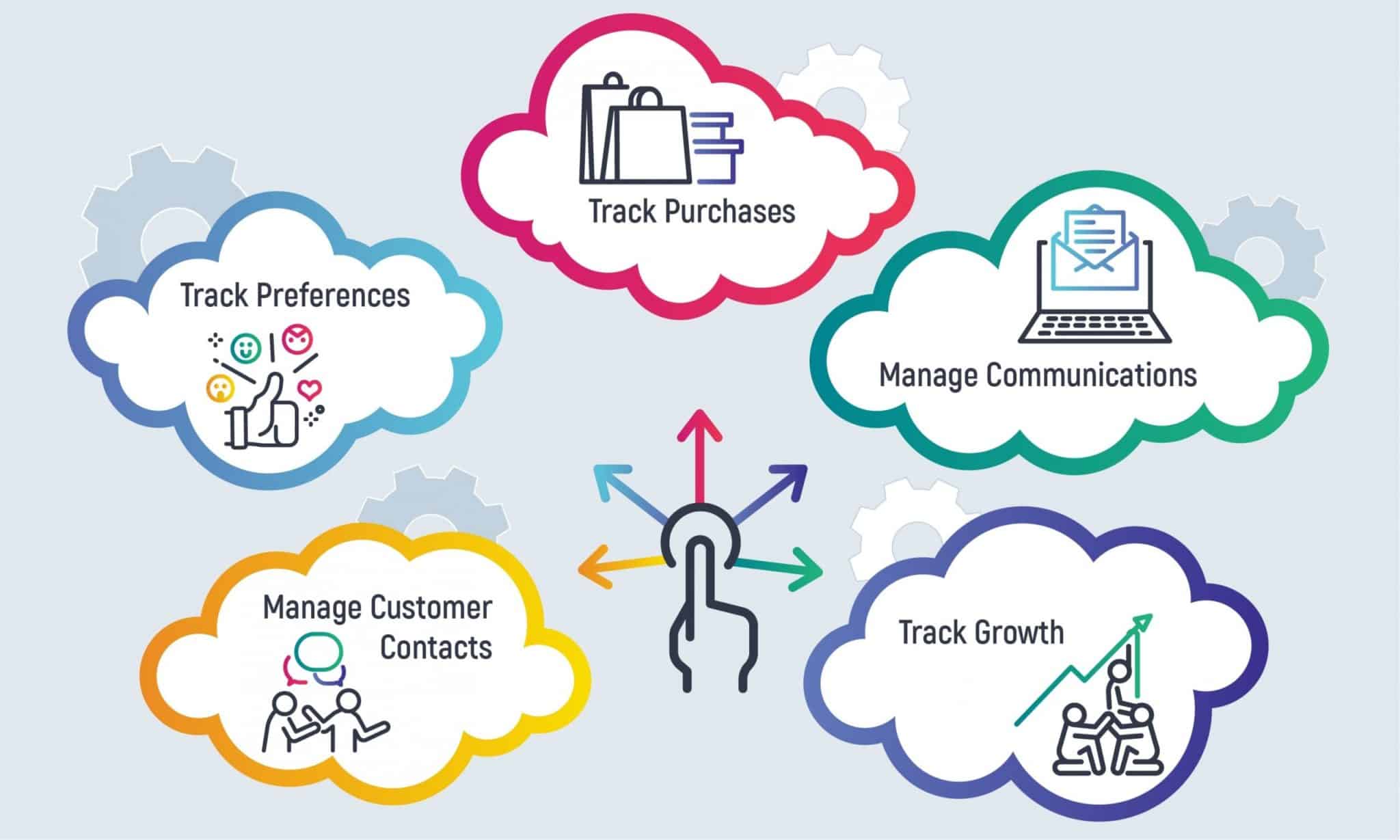
A 5% lift in customer retention can boost bank profits anywhere from 25% to 95%But retention doesn't improve on its own. Modern CRM gives your bank the data, segmentation, and automation to turn retention into a repeatable, measurable growth driver.


Banks treating it as strategic infrastructure are growing wallet share while fintechs compete for the same customers. Those treating it as a contact database are leaking revenue, one missed signal at a time.


Our guide walks through the types of CRM in banking, the features that translate directly into ROI, and the six business benefits that justify the investment. Also, you’ll find the challenges banks hit during implementation and a practical 7-step roadmap for getting it right.

Contents

Key Takeaways

  • Analytical CRM is the revenue-tied category, with predictive churn scoring and next-best-action recommendations that cut your attrition 25% to 40% when paired with AI
  • A unified 360-degree customer view turns cross-sell from guesswork into automatic next-best-product recommendations, and flags churn weeks before the customer leaves.
  • 72% of organizations have integrated AI into at least one business function, and financial services are leading the shift from pilot to scaled CRM deployment
  • Personalization at scale is how your bank competes with fintechs that lack your balance-sheet depth but own better data pipelines
  • Most banking CRM programs fail at sequencing, with integration-before-governance and training-before-workflows being the two most expensive mistakes

Case Study: Inoxoft Cut a UK Trading Platform’s Order Time from 90 Seconds to 30 Seconds

A UK-based group of currency traders operating across the world’s three major stock exchanges (London, New York, and Tokyo) came to Inoxoft with a clear problem. 

Their team had developed proprietary financial strategies and mathematical models to profit from currency price fluctuations, but every step of the workflow, from exchange-rate research and data consolidation to strategy application and broker communication, was still done by hand. They asked us to automate it. 

The Challenge

Manual trading operations created a bottleneck that directly limited profit. The team needed a system that could:

  • Ingest hourly currency exchange-rate data and structure it into usable formats
  • Apply proprietary strategies in real time across the full dataset
  • Generate profitable currency purchase orders automatically
  • Push orders to licensed brokers fast enough to execute before market conditions change


The engineering problem was significant: build a platform that runs complex mathematical operations in parallel, maintains synchronization across services, and delivers results in seconds.

What We Built

Inoxoft delivered a custom web application that automated the full trading workflow end-to-end:

  • Real-time ingestion of exchange-rate data from three global stock exchanges
  • Parallel execution of proprietary financial formulas across currency pairs
  • Automated order generation based on the active trading strategy
  • FIX 4.4 protocol integration for direct broker communication
  • Queue-based calculation sequencing that processes every currency pair in real time


Project shape: 7 months, 3 software engineers, 1 QA engineer, 1 project manager. 

Tech stack: Python (Django), Celery, RabbitMQ, Redis, PostgreSQL, AWS EC2, FIX 4.4, Quickfix, Pandas, Multiprocessing.

The Results

  • Order generation time cut from 1 minute 30 seconds to 30 seconds, a 67% reduction
  • Real-time numerical analysis at high volume across three time zones
  • Automated broker communication, replacing manual handoffs and enabling faster execution
  • Service-to-service synchronization between data ingestion, calculation, and order placement
  • Manual workload is eliminated from the critical path of every trade decision


The engineering patterns behind this trading platform (real-time data processing, third-party protocol integration, and automated decisioning) are the same ones that separate a modern banking CRM from a glorified contact database.

Book a consultation with Inoxoft to explore how we can apply that same engineering depth to your customer relationship management program.

What Is Customer Relationship Management in Banking?

Customer relationship management in banking is the combined strategy and software system banks use to manage every customer interaction. A banking CRM centralizes client data from branches, mobile apps, call centers, and online banking into one profile. Then, it uses that unified view to deliver personalized service, targeted offers, and faster support.

The distinction from a generic CRM matters. 

A standard CRM tracks deals and contacts. A banking CRM handles regulated financial data, integrates with core banking platforms, meets compliance standards like GDPR and PCI DSS, and supports workflows specific to retail and corporate banking. These include account opening, loan origination, KYC checks, fraud monitoring, and wealth advisory.

The business impact is immediate: centralized data drives cross-sell, predictive insights flag churn before accounts close, and automation frees relationship managers for high-value advisory work.

A modern CRM in banking typically unifies:

  • Customer data that powers segmentation and personalized pricing
  • Interaction history across branches, calls, chats, app sessions, and emails, which shortens resolution times and eliminates repeated customer explanations
  • Product holdings, including checking, savings, loans, cards, mortgages, and investments, which surface cross-sell opportunities the moment a customer qualifies
  • Service tickets and complaints with sentiment signals, which flag churn risk weeks before the account closes
  • Marketing touchpoints, including campaign responses, offer engagement, and next-best-action triggers, which lift conversion rates on every outreach


A core banking system records transactions. A CRM interprets the relationship behind them and turns it into revenue. It answers the questions a ledger cannot: who the customer is, what they are likely to need next, and whether they are about to leave. 

Types of Customer Relationship Management in Banking and What They Deliver to Your Business

Banking CRMs are typically grouped into three categories: operational, analytical, and collaborative. Each solves a different business problem, and modern platforms blend all three. The practical question for most banks is which capability closes the biggest revenue or efficiency gap right now. 

Let’s look at the core CRM in banking sector types’ comparison table before moving into detail:

CRM type

Primary function

Best fit

Key banking outcomes

Operational

Automates front-office sales, marketing, and service workflows

Banks with manual processes, spreadsheets, or legacy workflows

Lower cost-to-serve, faster onboarding, higher agent productivity

Analytical

Turns customer data into predictive insight

Banks focused on revenue growth, retention, and personalization

Higher cross-sell conversion, earlier churn detection, smarter pricing

Collaborative

Unifies customer data across branches, channels, and teams

Banks with complex, multi-channel customer journeys

Faster resolution, consistent service, higher NPS

Operational CRM

Operational CRM automates the day-to-day work of the front office across sales, marketing, and customer service. For your bank, it handles digital onboarding, marketing campaigns, appointment scheduling, and provides loan processing automation

Key business outcomes:

  • Lower cost-to-serve through workflow automation that removes manual handoffs
  • Shorter onboarding times for new account holders and loan applicants
  • Higher agent productivity, with less time spent on data entry and more on client-facing work
  • Faster lead routing from marketing campaigns straight to relationship managers


Operational CRM is usually the first investment for banks that still rely on spreadsheets, email, or legacy systems to manage customer workflows. If that describes your current setup, the labor savings are easy to quantify, which makes ROI straightforward to justify. 

Analytical CRM

Analytical CRM turns the data your bank already captures into predictive insight. It applies data mining, machine learning, and business intelligence to identify which customers are about to churn, which are ready for an upsell, and which segments respond best to specific campaigns. 

What to expect:

  • Higher conversion on cross-sell and upsell offers
  • Earlier churn intervention through predictive scoring
  • Smarter pricing and product decisions based on segment behavior
  • Better-targeted marketing spend and higher campaign ROI


Analytical CRM in banking is the type most closely tied to revenue. It powers next-best-action recommendations, dynamic segmentation, and predictive churn scores that can cut attrition by 25-40% when paired with AI.

Collaborative CRM

Collaborative CRM breaks the silos between branch, contact center, mobile app, email, and back-office teams. Every team works from the same customer profile, so your clients do not have to repeat their story each time they switch channels. 

Measurable results:

  • Faster issue resolution across every channel
  • Consistent service at every touchpoint, from branch to app
  • Higher Net Promoter Score and lower reputational churn
  • Shared context between front-office, back-office, and specialist teams


Collaborative customer relationship management in the banking sector matters most when customer journeys are complex, including retail clients who also hold business accounts, wealth customers managed across branches and digitally, and corporate clients with multiple relationship managers. 

Key Features of a Modern CRM in the Banking Sector

A banking CRM earns its seat at the strategic table only when its features translate directly into revenue, retention, efficiency, or risk reduction. Modern platforms, whether off-the-shelf or custom-built, tend to converge on the same capability clusters. 

Unified 360-Degree Customer View

A unified customer profile is the foundation on which every other feature in your CRM depends. It pulls data from core banking, the loan origination system, the mobile app, the contact center, marketing platforms, and third-party sources into one real-time record. The difference it makes is easiest to see when you compare the before and after of a relationship manager’s day. 

Without a unified view

With a unified 360-degree view

Advisor opens 4–5 systems to prepare for a client call

One dashboard shows accounts, interactions, life events, and open tickets

Customers repeat their story at every channel

Consistent context across branch, app, contact center, and email

Cross-sell happens by guesswork

Next-best-product recommendations appear automatically

Churn signals surface after the customer leaves

Behavior and sentiment flags appear weeks in advance

Workflow Automation Across the Customer Lifecycle

Every front-office workflow in your bank carries a manual cost: hours of data entry, duplicated effort, SLA breaches, and leads that go cold. Modern CRMs in the banking sector replace each one with a triggered, auditable, and measurable process. Run the whole customer journey end to end, and you can see the compound effect: 

  1. Marketing triggers an offer based on a life event detected in transaction data. No manual list pull.
  2. The lead routes to the right relationship manager the moment the client clicks. No spreadsheet handoffs.
  3. Onboarding runs digitally, with KYC checks completed in minutes instead of days.
  4. Appointments are booked through calendar sync with the advisor’s actual availability.
  5. Service tickets are opened, escalated, and closed against the SLA, with the full interaction history attached.
  6. Loyalty rewards trigger automatically when a client hits a milestone, tailored to their product mix.

AI-Powered Analytics and Predictive Insights

AI has moved from optional to table-stakes in modern CRMs in banking. The analytics layer ingests transaction data, digital behavior, and interaction history and turns it into decisions a human could never make at scale: which customer to call today, which offer to send tomorrow, which of your accounts is three weeks from closing.

This is where the business case shifts from operational efficiency to measurable revenue lift. Predictive churn scoring lets you intervene weeks before a customer walks away. Next-best-action engines surface the exact product a client is ready to accept, based on their behavior. 

Generative AI assistants now draft relationship-manager emails, summarize long customer histories, and resolve routine service questions without pulling an agent into the queue.

Compliance, Security, and Fraud Prevention

Customer relationship management in banking handles your customers’ personally identifiable information, transaction records, and credit data. The compliance and security layer is not a back-office feature. It determines whether the entire CRM can be deployed at all. A modern banking CRM protects your business across three layers: 

  • Regulatory compliance. Every CRM deployed in a bank must map to the standards its customers and regulators demand. The table below summarizes the ones that matter most.


Standard

What it covers

Business impact

GDPR

EU customer data privacy and consent

Avoids fines of up to 4% of global revenue

PCI DSS

Payment card data protection

Prevents cardholder data breaches and liability

KYC / AML

Customer identity verification and anti-money-laundering

Supports onboarding compliance and regulatory reporting

SOC 2

Data handling and operational controls

Required by most enterprise procurement processes

ISO 27001

Information security management

Signals security maturity to partners and regulators

  • Data security. Role-based access controls, encryption in transit and at rest, and full audit trails ensure that only the right people see the right data and that every action is logged for forensics.
  • Fraud prevention. Real-time transaction and behavior scoring flags anomalous activity the moment it happens, reducing fraud losses and stopping account takeovers before they escalate.

Integration With Core Banking and Legacy Systems

A CRM in banking that cannot integrate is a data silo with a nicer interface. The real value comes from bidirectional data flow between the CRM and the bank’s systems of record. 

What does a banking CRM need to integrate with?

The short list covers core banking platforms, loan origination and servicing systems, mobile and online banking channels, marketing automation, customer data platforms, fraud and KYC providers, credit-bureau services, and BI or data warehouse tooling. 

What breaks without proper integration?

Data drifts out of sync. A client opens a loan in one system, and the CRM still lists them as a prospect. Marketing sends an offer that the client just accepted in a branch. Service agents quote balances that are minutes out of date. Every one of those moments damages trust and costs revenue. 

What is the cost of getting it wrong?

Re-implementation is the most expensive answer to a bad integration decision. If you invest early in API-first CRM architectures, your bank moves faster on product launches, cross-sell campaigns, and regulatory reporting. 

Benefits of Customer Relationship Management in the Banking Sector

Banks invest in CRM because the returns are measured in areas the CFO can track: retention, revenue per customer, operational costs, and risk exposure. Here are 6 benefits with the strongest business cases and the clearest paths to ROI. 

Six benefits of CRM in banking including higher customer retention, cross-sell revenue growth, and fraud detection

Higher Customer Retention and Lifetime Value 

US banks lose an estimated $195 billion annually to customer churn. 

That number is the P&L argument for CRM in one line, and every percentage point your bank can reclaim goes straight to the bottom line. For your bank, the CRM payoff compounds. A retained customer deepens their wallet over time, adding mortgages, cards, investment products, and wealth services. 

CRM makes retention operational. It flags at-risk customers weeks before they leave, prioritizes relationship manager outreach over actual churn signals, and automates win-back journeys the moment a client goes quiet. The result is a retention program that runs as a continuous workflow. 

You cannot protect the lifetime value you cannot see. A CRM in banking makes lifetime value visible and scoreable.

Revenue Growth Through Cross-Sell and Upsell

A customer with one product has an exit ramp. A customer with four or five products has a relationship. CRM is what moves people across that threshold, because it pattern-matches customer behavior against revenue opportunity in real time.

The signal-to-action logic is what drives cross-sell revenue:

When the CRM sees this

Your team can act on this

Salary deposit grows 20% over 3 months

Offer higher-yield savings or a wealth-management intro

Large outflow to a mortgage broker

Trigger a competing mortgage rate offer

New joint account opens

Upsell a joint card or family insurance product

Transaction patterns suggest business activity

Convert a retail client into a business-banking relationship

Child dependent added as beneficiary

Offer education savings or life insurance products

Personalized Customer Experiences at Scale

AI-driven CRM in the banking sector treats every customer as themselves, dynamically, based on what they are actually doing right now.

What personalization at scale looks like in practice:

  • Offers that change based on spending rhythm, savings behavior, and digital engagement
  • Adaptive customer journeys that reroute when a client ignores one message and engages with another
  • Relationship-manager dashboards that surface the right talking point for the next call
  • Timing that respects the client’s channel preference and the hour of the day


Personalization is how your bank competes against fintechs that lack your balance-sheet scale but own better data pipes.

Leed Magnet image

Maximize Your ROI with Confidence

Think you know custom software ROI? It’s more complex than it seems! Get templates to calculate fintech ROI and make smarter decisions.

    Please prove you are human by selecting the Plane.

    Thank You!

    Your PDF guide is on its way. Check your email shortly!

    Operational Efficiency Through Automation

    Every manual hour in your front office is a cost line. Customer relationship management in the banking sector reduces those hours one workflow at a time, and the savings compound quickly.

    Task

    Manual effort (typical)

    With banking CRM

    New account onboarding

    2–3 days, paper forms, back-office verification

    Under 10 minutes, digital KYC, auto-approval for low-risk

    Lead handoff from marketing to RM

    Hours to days, email or spreadsheet

    Real-time, routed by territory and product fit

    Customer case resolution

    Multiple agents, no shared context

    One agent, full history, SLA-tracked

    Marketing list building

    Manual CSV exports, weekly cycle

    Dynamic segmentation, continuous refresh

    Cross-sell opportunity detection

    Quarterly reports, retrospective

    Real-time signals pushed to the advisor

    Sharper Insights Into Customer Behavior

    A CRM is only as useful as the questions it lets your team answer. Modern banking CRMs turn every transaction, interaction, and engagement signal into a data point that can be queried, scored, and acted on. These are the questions your bank can now answer in minutes rather than months:

    1. Who is most likely to leave in the next 60 days, and why?
    2. What marketing campaign produced the highest lifetime-value customers last year?
    3. Who qualifies for a cross-sell right now, and what is the next-best product to offer?
    4. How do your relationship managers compare on cross-sell revenue per hour spent?
    5. Where does digital outreach outperform human contact, and where is it the opposite?
    6. What product-feature combinations correlate with the highest retention?


    Each answer translates to a concrete business decision: whether to intervene, invest, reallocate, or double down. The banks that win the next decade will not be the ones with the most data; they will be the ones that ask the best questions of it.

    Fraud Detection and Risk Reduction

    Fraud prevention is the quiet, high-ROI side of CRM in banking that rarely leads a vendor demo but moves real dollars.

    What a banking CRM detects. Anomalous transaction patterns, unusual login geographies, sudden behavioral shifts, beneficiary changes on sensitive accounts, and cross-channel signals that would look harmless in any single system.

    How does CRM detect them? Real-time scoring against machine-learning models trained on your own historical fraud data, enriched with third-party fraud feeds and behavioral biometrics.

    What CRM saves your bank. Direct fraud losses, chargeback exposure, regulatory penalties for weak AML controls, and the reputational damage of a high-profile breach. 

    How AI Is Reshaping Customer Relationship Management Practices in the Banking Industry

    AI has crossed the line from pilot project to core CRM infrastructure in banking. 72% of organizations have integrated AI into at least one business function, with financial services moving fastest from experimentation to scaled deployment across customer operations. 

    Here are capabilities where AI is producing measurable business outcomes inside banking CRM today. 

    Predictive Churn Scoring

    Predictive churn scoring is where most banks first see measurable AI ROI. Machine-learning models trained on your historical churn data combine transaction patterns, engagement frequency, balance trends, and service-complaint signals into a single number: the probability that a specific customer will close their account in the next 30, 60, or 90 days.

    Picture the workflow. A retail client’s churn score climbs from 0.22 to 0.71 over three weeks. The system automatically flags the account for the relationship manager’s queue, generates a suggested talking point, and triggers a retention offer workflow. By the time the client is actively considering leaving, your team has already reached out. That is the shift from reactive to pre-emptive retention.

    Next-Best-Action (NBA) Recommendations

    Most CRM in banking still makes offers the way direct marketing did in 2005: segment everyone, blast a campaign, measure open rates. Next-best-action replaces that approach with a real-time recommendation engine. The question changes from “which segment does this customer belong to” to “what should happen for this specific customer, right now.”

    Banking NBA typically matures in 3 levels:

    Level 1: Rule-based NBA. Simple triggers fire predefined actions. “If a customer opens the mortgage inquiry page three times in a week, send a rate-lock offer.” Useful for quick wins, but limited to patterns someone thought to write down.

    Level 2: ML-based NBA. Machine-learning models learn what works from historical conversion data and continuously adjust the ranking of recommendations. Your relationship managers see the top three next actions for each client, each with a confidence score attached.

    Level 3: Contextual, real-time NBA. The engine factors in live channel, device, time of day, and emotional signal (from call transcripts and message sentiment). The recommendation changes if the client is frustrated vs. exploring, or opened the app vs. calling the branch.

    AI Agents as Digital Relationship Managers

    AI agents are the frontier of customer relationship management practices in the banking industry. These autonomous systems can hold a conversation, reason through a customer need, execute a transaction, and hand off to a human only when judgment or compliance demands it. For your bank, they represent a genuine expansion of the front-office workforce.

    The practical landscape in 2026:

    What AI agents do today

    What they will do next

    What stays human

    Handle routine service queries end-to-end (balances, transfers, card blocks)

    Manage full product journeys from rate comparison to application submission

    Complex advisory, wealth strategy, dispute resolution

    Proactively reach out based on NBA triggers

    Act as always-on relationship managers for mass-affluent segments

    High-value corporate and private-banking relationships

    Escalate emotional or compliance-sensitive calls to humans

    Coordinate across multiple bank systems without human intervention

    Final authorization on high-risk transactions and complex compliance

    Generative AI for Customer Service

    Generative AI is the most visible application of AI inside modern CRMs in the banking sector because it touches both the agent and the customer. For your bank, the question is no longer whether to use GenAI but where in the service workflow it pays back the fastest.

    The agent copilot

    A relationship manager preparing for a 9 a.m. client call used to skim five systems for context. With a GenAI copilot embedded in the CRM, the same prep produces a 60-second summary: recent transactions, open complaints, the last three conversation themes, and two suggested talking points. The result is shorter prep time, more substantive calls, and advisors who arrive ready.

    The customer-facing chatbot

    Generic scripted bots frustrated more customers than they helped. GenAI chatbots draw on the CRM’s full context, which means they answer a customer’s balance question while also recognizing that the customer just missed a mortgage payment and routing them to a retention specialist before the conversation escalates. Resolution rates climb, and transfer rates drop.

    The case-closure assistant

    After a service call, an agent used to spend three to five minutes typing case notes. GenAI now summarizes the interaction, classifies the issue, and drafts the follow-up email, all of which are reviewed and sent by the agent in under 30 seconds. The recovered time is returned to cases your bank actually needs humans for.

    Common Challenges of Customer Relationship Management in Banking and How to Solve Them

    Each bank that has deployed a CRM has encountered similar problems, including legacy integration issues and compliance risks. The good news is that each challenge has a proven solution path. Let’s review the problems your bank is most likely to face and how to address them, thereby improving specific business outcomes. 

    Four challenges of customer relationship management in banking including legacy system integration, GDPR compliance, user adoption, and data fragmentation

    Integration With Legacy Core Banking Systems 

    The biggest technical obstacle to successful customer relationship management in banking is almost always the core system underneath it. 

    Most banks still run on core banking platforms that were architected decades before modern APIs existed. Your CRM expects real-time data flow, but many legacy core systems still deliver nightly batch exports. The mismatch is where many CRM programs quietly fail, because such systems that only see yesterday’s data cannot power today’s customer decisions. 

    Integration approach

    Costs your bank

    When it fails

    Direct point-to-point connections

    Expensive to maintain, slow to change

    Every time a core system upgrades

    Batch file exports

    Stale data, no real-time personalization

    As soon as customers expect live balances and offers

    Middleware without an API strategy

    Rigid architecture, years to change, high licensing cost

    When you need to add a channel or partner

    API-first integration layer

    Higher upfront cost, lowest long-term friction

    Rarely, if governance is in place

    To solve it, treat integration as a strategic architecture decision. Build an API layer between your core banking platform and the CRM, so the CRM reads and writes through a standard interface. If your core system is genuinely not API-capable, a modern integration partner can wrap it in middleware that exposes the data your CRM needs without replacing the underlying platform.

    The business outcome is that your bank gets real-time customer data, faster product launches, and the flexibility to change platforms later without rebuilding every integration from scratch. 

    Data Security and Regulatory Compliance (GDPR, PCI DSS) 

    Banking CRMs concentrate the most sensitive data your bank holds: identity documents, transaction history, credit profiles, and behavioral signals. Regulators know this, which is why fines are so high. 

    The risks banks actually face:

    1. Unauthorized access. Staff sees customer data they have no business reason to access.
    2. Data residency breaches. Customer records cross borders in ways the regulator did not approve.
    3. Consent drift. Marketing uses data that customers never opted in to share.
    4. Audit failures. CRMs in banking cannot provide a complete record of who accessed what and when.
    5. Third-party data gaps. An integrated system may operate under security standards different from those in your environment.


    Build compliance into the CRM architecture from day one to overcome this problem. That means role-based access control mapped to real job functions, field-level encryption for regulated data, explicit consent tracking tied to every marketing touchpoint, and full audit trails that cover both user actions and system events. 

    Your procurement process should require SOC 2 and ISO 27001 certification from any platform that handles customer data. Thanks to it, your bank passes audits the first time, avoids high fines, and gives customers a reason to trust you with data.

    User Adoption and Staff Training 

    Low user adoption is the quietest customer relationship management failure mode in banking. Banking software works, and data is clean, but the advisors keep their client notes in Excel, the branch staff skips the CRM screens during account openings, and the service team treats it as a ticketing system. When that happens, the CRM becomes an expensive database.

    Why adoption fails in banking:

    • Training focuses on screen navigation
    • Workflows are designed for the system 
    • Front-line staff were not consulted during the design phase, so the CRM feels imposed from above
    • Incentives still reward activity captured outside the CRM, so there is no reason to log things inside it
    • Leadership does not use the CRM itself, so the signal from the top is that it does not matter


    You should treat adoption as a change-management program: 

    • Involve front-line staff in workflow design
    • Tie the commission and KPI tracking to CRM data
    • Train on outcomes
    • Have executives use the same dashboards they expect their teams to populate
    • Measure adoption by behavior


    The business outcome: your CRM investment gets used, the data inside stays trustworthy, and every downstream capability, including analytics, AI, and automation, works because the underlying data is clean.

    Data Fragmentation Across Channels

    Every channel your bank runs creates its own copy of the customer, and none of them tells the whole story.

    The mobile app knows app behavior. The call center knows tickets. Branch staff know face-to-face conversations. Marketing knows email engagement. The core system knows transactions. Without a deliberate data strategy, these systems never reconcile, which means your CRM in banking ends up with 5 incomplete customer records instead of one complete one.

    What goes wrong without unified data:

    • Relationship managers see one customer, the marketing team sees a different version of the same customer, and the two make contradictory decisions
    • AI in banking trains on incomplete histories and produces unreliable churn and cross-sell predictions
    • Customers notice the inconsistency when the app offers them something the branch already sold them yesterday
    • Regulatory reports take weeks to compile because data has to be stitched together from multiple systems
    • Every new channel you launch makes the problem worse

    How to solve data fragmentation

    Designate a single system of record for customer identity and relationship data, typically the CRM or a customer data platform that feeds it. Build pipelines that standardize, deduplicate, and enrich data as it flows in from every channel.

    Invest in master data management so that one customer equals one record, with a clean history, no matter which channel the interaction originated. Your AI recommendations become reliable, your relationship managers trust the data they see, and every channel reinforces the same customer relationship instead of competing with it.

    Off-the-Shelf vs. Custom CRM in Banking: Which Is Right for You?

    The customer relationship management in banking decisions almost always comes down to a single question: buy a platform or build a system specifically for your bank? 

    Both paths deliver real business outcomes. The wrong path wastes budget, delays time-to-market, and leaves capability gaps that compound for years. Now, we look into this question and weigh the pros and cons.

    Off-the-Shelf Banking CRM

    Off-the-shelf CRM products for the banking sector are mature, feature-rich, and backed by global vendors with robust compliance documentation. If your bank runs on mainstream retail and commercial workflows, an off-the-shelf platform can deliver what you need within weeks. 

    You get predictable licensing, a five-year TCO your finance team can model, a roadmap maintained by the platform provider, and certifications (SOC 2, ISO 27001, GDPR, PCI DSS) you inherit rather than build.

    The tradeoff is the ceiling. Off-the-shelf platforms fit your processes to their model. If your differentiation depends on how you handle onboarding, cross-sell, or relationship management, an off-the-shelf tool may make your bank look like every other bank using the same platform.

    Custom Banking CRM

    Custom customer relationship management in banking sector systems systems make sense when the specifics of how your bank operates are themselves a source of competitive advantage. The investment is larger, and the timeline is longer, but the payoff is a system shaped to your bank.

    What you gain with custom

    • Workflows designed around your actual processes
    • Data model that matches your core banking, product, and segmentation logic exactly
    • Full control over integrations and architectural independence
    • Competitive differentiation in experience, personalization, and AI features
    • Lower long-term licensing costs on systems that will run for a decade
    • Freedom to embed proprietary risk, pricing, and compliance logic

    What the investment requires

    • 6 to 18 months to first production release, depending on scope
    • Dedicated engineering budget plus ongoing maintenance commitment
    • Experienced development partner with banking domain knowledge
    • Clear product ownership inside your bank
    • Higher upfront capital investment
    • Stronger internal change management


    Custom is the right path for challenger banks, private banks, and digital-first institutions whose edge depends on experiences that cannot be purchased off a shelf. It is also the right path when your core system or compliance regime is sufficiently unusual that mainstream platforms will not fit without extensive, brittle customization.

    How to Choose

    The right decision on CRM in banking comes from scoring your bank against the factors that matter, then letting the math guide the recommendation. 

    The scorecard below is a practical starting framework you can adapt. You need to rate each factor based on your situation, weigh it against the others, then compare totals.

    Decision factor

    Off-the-shelf scores higher when

    Custom scores higher when

    Time to market

    You need to deploy within 3 to 6 months

    You can invest 12 to 18 months for a strategic advantage

    Budget profile

    You prefer predictable OpEx (subscription)

    You can commit CapEx and build long-term asset value

    Workflow specificity

    Your processes align with industry norms

    Your workflows are a source of differentiation

    Core system compatibility

    Your core is Temenos, Finastra, FIS, or similar mainstream

    Your core is legacy, regional, or heavily customized

    Compliance complexity

    Your regulatory needs fit standard frameworks

    You face unusual or multi-jurisdictional requirements

    Data and AI maturity

    You are starting your AI journey

    You have a strategic AI roadmap and want full control

    Platform dependency

    You are comfortable with long-term platform reliance

    You want architectural independence

    Differentiation strategy

    Banking is commoditized in your market segment

    Customer experience is your competitive edge


    How to Implement CRM in Banking: 7-Step Roadmap

    Most banking CRM projects that fail did not fail at the technology layer. They failed at sequencing. For example, starting integration before governance, or training before workflows were designed. 

    Here’s a 7-step roadmap to protect the budget, momentum, and user adoption during a typical customer relationship management (CRM) rollout in banking.

    Seven-step roadmap to implement banking CRM from defining strategic goals through measuring and scaling

    Step 1: Define Strategic Goals and KPIs

    Before you evaluate any vendor of CRM in the banking sector, decide what your bank is trying to achieve. Is it retention? Cross-sell? Time-to-onboard? Agent productivity? 

    Pick two or three KPIs you will use to judge success, baseline them today, and set a 12-month target. Every downstream decision (software, data model, training plan) should be guided by those numbers.

    Example KPIs to baseline: 12-month retention rate, cross-sell ratio per active customer, average account-opening time, and first-call resolution rate.

    Step 2: Audit Current State

    An honest audit prevents the two most expensive implementation surprises: duplicate data you did not know about and systems nobody will let you turn off. Walk through these questions before scoping anything:

    • Where does your customer data actually live today, and which system owns the master record?
    • Which channels capture interactions outside the current CRM, and how do they reconcile?
    • Which workflows still run on spreadsheets, email, or manual handoffs?
    • Which legacy systems must stay in your architecture, and which are candidates for retirement?

    Step 3: Assemble the Team and Governance

    Your implementation needs a named owner, a steering group that makes decisions, and cross-functional representation across your bank that extends beyond IT. A working setup looks like this:

    Role

    Responsibility

    Executive sponsor

    Protects the budget, resolves escalations

    Program lead

    Owns timeline, scope, and delivery

    Business leads (retail, wealth, ops)

    Define workflows and priorities

    Data lead

    Owns data model, quality, and migration

    Integration lead

    Owns core-banking and channel connections

    Change-management lead

    Drives adoption, training, and communications

    Step 4: Design Workflows and Data Model

    Start with your customer data model: one definition of a customer, one identity key, one source of truth. Then design workflows around how your team actually does the work (onboarding, servicing, complaints, cross-sell). Only then configure the CRM. Skip this order, and you will rebuild the same module three times.

    Step 5: Integrate With Core Banking and Channels

    Your bank has dozens of potential integrations. Do them in this order:

    1. First wave (months 1-3): core banking for customer and account data, plus identity and KYC providers. Without these, nothing works.
    2. Second wave (months 3-6): channels your customers use most (mobile, online, contact center). Without these, the CRM has no impact on the customer experience.
    3. Third wave (month 6+): analytics, marketing automation, loyalty, and third-party enrichment. These amplify value but do not gate go-live.

    Step 6: Pilot, Train, and Roll Out

    Begin with a pilot in one branch, region, or product line to validate workflows in your environment and surface real-world friction before it spreads to the rest of the bank. 

    Once the pilot is working, train your staff on outcomes, showing advisors how the CRM saves them 30 minutes per client meeting instead of how to click through menus. Then roll out in waves, with the pilot team supporting the next cohort through the handoff. A phased rollout costs your bank more in the short term but far less in the long term due to failed adoption.

    Step 7: Measure, Optimize, and Scale

    Track the KPIs you set in Step 1 monthly and pair them with leading indicators to see whether your system is being used as intended. The combination below is a starting dashboard most CRM in banking programs find useful:

    Metric

    Target

    What it signals

    Active user rate

    >85% of eligible staff

    Adoption is real

    Data completeness

    >95% on key fields

    Downstream AI and analytics will be reliable

    Churn in the at-risk segment

    Lower vs. baseline

    Retention workflows are working

    Cross-sell ratio

    Higher vs. baseline

    Next-best-action and segmentation are paying off

    Why Build a Banking CRM with Inoxoft

    Inoxoft is a custom banking software development company with 10+ years of experience building products for fintech, banking, and capital markets clients. 

    Our team of 200+ in-house engineers covers fintech, AI/ML, data science, and secure SDLC, and has delivered 200+ projects ranging from startup MVPs to enterprise-scale financial platforms. 

    We are ISO 27001 certified, hold partnerships with Microsoft and Google Cloud, and deliver from our Philadelphia headquarters to clients across the US, UK, and EU. 

    Here is what you get working with us:

    • Banking CRM software development. We design and build CRM systems tailored to your workflows, data model, and compliance posture.
    • Legacy integration and API modernization. Our engineers wrap older core banking platforms in API layers that expose the data your CRM needs, so you get real-time flow without replacing the underlying systems.
    • AI and ML are built into the CRM. Predictive churn scoring, next-best-action engines, GenAI copilots for agents, document intelligence on KYC flows. We embed AI where it moves the business.
    • Compliance-first delivery. GDPR, PCI DSS, SOC 2, ISO 27001, KYC/AML: we work to the standards your auditors require, and your customers expect, with secure SDLC practices baked into every sprint.

    Planning a banking CRM program? Whether you are modernizing an off-the-shelf platform, building a custom system, or layering AI onto what you already have, book a discovery call, and we will map the scope, timeline, and business case with you in one session. 

    Final Thoughts

    Customer relationship management in banking has moved from a contact database to the backbone of retention, cross-sell, personalized service, and risk control. For your bank, that shift changes the economics of every customer relationship. Modern CRM, especially when paired with AI, closes that gap, and the banks that do so fastest will define the next decade of banking.

    Whether you choose off-the-shelf, custom, or hybrid, whether you roll out AI on day one or in phase three, the difference between a CRM that compounds in value and one that gathers dust is the same: a clear business case, a sequenced rollout, and an organization committed to using the system the way it was designed. Start with the business outcomes you want to move, and the technology decisions follow.

    Planning a banking CRM program takes a clear business case, a realistic scope, and a partner who has done it before. Book a discovery call with Inoxoft, we’re ready to help you build successful software that will drive measurable outcomes. 

    Frequently Asked Questions

    How does customer relationship management in banking improve the loan approval rate for retail clients?

    A banking CRM raises approval rates by giving loan officers a complete, verified view of the applicant before the application is even submitted. Because the CRM already holds transaction history, product holdings, income patterns, and credit behavior, it pre-qualifies customers silently in the background and surfaces them for proactive, pre-approved offers instead of cold applications.

    A CRM-driven lending workflow supports higher approval rates because:

    • Behavioral data feeds the eligibility model
    • Documentation and KYC checks are already complete for existing customers
    • Pre-approved offers target people who have already been qualified, so the funnel starts cleaner
    • Real-time integration with credit bureaus and alternative data sources returns decisions in minutes
    • Risk signals trigger earlier intervention, reducing late-stage rejections

    Can a banking CRM integrate with third-party credit scoring fintechs to provide real-time lending decisions?

    Yes. Modern banking CRMs expose the API hooks needed to call out to third-party credit scoring providers, alternative-data fintechs, and KYC services during the loan application flow. 

    The CRM submits the applicant's data to one or more scoring models, aggregates the responses, and returns a decision inside the same workflow the relationship manager or customer is already using. This is how most digital lending works today, and it is a key reason API-first CRM architecture matters for any bank planning to compete on speed of credit. 

    What are the most effective strategies of customer relationship management in the banking sector for managing high-net-worth individuals?

    HNWI relationships are built on discretion, personalization, and proactive service, and CRM is what operationalizes all three at scale. The strategies that work consistently for private banking and wealth teams include:

    • One relationship manager, one complete view, so the RM sees accounts, holdings, family structure, and preferences in a single profile
    • Life-event triggers that alert the team to milestones (business sale, inheritance, property purchase) that change the client's advisory needs
    • Proactive portfolio reviews scheduled on a cadence the client prefers, with agenda items pre-populated from CRM-generated insights
    • Discreet communication routing so sensitive topics are handled through the channels and advisors the client has explicitly approved
    • Cross-generational relationship tracking that preserves context when wealth transfers to the next generation

    How do customer relationship management practices in the banking industry differ between traditional brick-and-mortar banks and digital-only neobanks?

    Traditional banks and neobanks both rely on CRM, but the weight they place on each part of the system is different. Neobanks have no branch network to lean on, so the CRM is effectively the product: every interaction happens in the app, and personalization, in-app messaging, and real-time data are what compete for the customer's attention. 

    Traditional banks have branches, relationship managers, and decades of legacy systems, so their CRM serves as an orchestration layer that unifies face-to-face, phone, branch, and digital channels into a single customer view.

    Neobanks typically move faster on AI, personalization, and experimentation because their systems are cloud-native from day one. Traditional banks usually have deeper product catalogs, larger customer bases, and more specialized teams (wealth, corporate, retail), which means their CRM has to integrate across more systems and serve more distinct workflows than a neobank needs.

    What are the primary technical barriers when migrating data to a cloud-based CRM in banking?

    Cloud CRM migration for a bank often fails because of the data that comes with it. The most common barriers are:

    • Legacy core banking integration, especially when the core lacks modern APIs
    • Data quality problems, including duplicate records, missing fields, and inconsistent customer identifiers across systems
    • Regulatory classification, where every data field needs to be tagged for residency, retention, and consent before it can move
    • Network and latency requirements for real-time workflows that depend on core-system data
    • Security review and penetration testing, which is mandatory for any system touching regulated financial data
    • Change-management overhead for staff who have built their workflows around the existing on-premise CRM